
Last updated September 3, 2026
Air Duct Cleaning Maintenance Checklist for Columbus Homeowners
The filter you check every month tells you almost nothing about what’s happening 15 feet deeper in your trunk line. After 11 years of pulling debris out of Columbus duct systems, we’ve found that homeowners who know what to look for between professional cleanings catch problems early — often extending the interval between full services and avoiding the kind of buildup that damages HVAC components. In Columbus, where our freeze-thaw winters pull in road salt dust and our humid summers create condensation zones inside ductwork, a simple 20-minute inspection routine can reveal more than a year’s worth of filter changes. This guide shows you exactly what to check, when to check it, and what’s worth calling a professional about. For a deeper look, see our Complete Guide to Air Duct Cleaning in Columbus.
Quick Answer
A proper air duct maintenance checklist for Columbus homeowners includes monthly filter checks, quarterly register inspections for debris and airflow changes, seasonal post-winter and post-summer deep assessments, and annual coordination with your furnace tune-up. Between professional cleanings, logging baseline airflow at each vent and noting visual or odor changes at registers lets you spot duct contamination, leaks, or blockages before they affect energy bills or indoor air quality.
Table of Contents
- The 20-Minute Room-by-Room Register Inspection
- Columbus Seasonal Triggers: When to Inspect More Closely
- How to Log Baseline Airflow at Every Vent
- Coordinating Your Checklist with Filter Changes and Tune-Ups
- Checklist Finding: DIY Fix or Call a Professional?
- Deep Maintenance Tasks Between Professional Cleanings
- Common Mistakes to Avoid
- When to Call a Professional
- Frequently Asked Questions
The 20-Minute Room-by-Room Register Inspection
Most Columbus homeowners look at their ceiling or floor registers and see either “clean” or “needs dusting.” But registers are actually diagnostic windows into your duct system. Here’s the inspection routine we teach customers who want to stay ahead of problems:
- Remove the grille, don’t just wipe it. Pop off each register cover with a flathead screwdriver. Look past the grille into the boot — the short duct section connecting your main line to the room. If you see debris accumulation more than 2 inches past the register opening, that’s beyond normal household dust.
- Check for discoloration patterns. Dark staining around register edges often indicates air leakage — conditioned air escaping into your wall or ceiling cavity, pulling attic or crawl space particles back through gaps. In Columbus’s older neighborhoods like German Village and Clintonville, where duct systems may be 40+ years old, this is especially common.
- Smell test each room individually. Close the door, turn the system fan on, and wait 30 seconds. Musty odors suggest moisture accumulation (a post-summer concern in Columbus’s humid climate). A slight oily or metallic smell can indicate motor bearing wear in your air handler — unrelated to ducts but worth noting for your HVAC technician.
- Feel for temperature consistency. In heating season, a register blowing noticeably cooler air than others often signals a disconnected or leaking duct in that branch. We’ve found separated flex duct in Columbus attics where winter temperature swings caused expansion and contraction at connection points.
- Photograph what you find. Date-stamped photos let you compare year-over-year. A boot that had light dusting last March and shows significant debris this March is telling you something about your system’s filtration or a developing leak upstream.
Pay special attention to registers in finished basements — common in Columbus’s ranch and split-level homes. These low-return configurations can pull in more settled particulate, and the visual access is easier than ceiling-mounted second-floor supplies.
Columbus Seasonal Triggers: When to Inspect More Closely
Columbus’s continental climate creates two distinct high-risk windows for duct contamination that most generic checklists miss.
Post-Winter: Late March to Early April
After months of closed-house heating, our inspection priority shifts to what we call “salt load.” Columbus’s road treatment protocols — calcium chloride and magnesium chloride blends — create fine particulate that enters homes on shoes, pets, and air infiltration. Your furnace has been recirculating this all winter. When we clean ducts in April, we regularly find grayish, slightly greasy buildup in return trunks that’s distinct from ordinary household dust. This residue is hygroscopic — it attracts moisture — making it a precursor to microbial growth if left through summer.
Your post-winter checklist additions:
- Inspect return air grilles more closely than supplies — they’re the collection point
- Check your furnace filter frame for bypass gaps where unfiltered air slips around the cartridge
- Note any new whistling or whistling-like sounds that weren’t present in fall — temperature cycling may have loosened duct connections
Post-Summer: September to Early October
Columbus’s July-August humidity averages above 70%, and any duct system with even minor leakage can accumulate condensation in wall cavities or attic spaces. By September, we see the results: musty odors, visible mold spotting on register grilles, or customer complaints of “allergy season” that don’t align with pollen counts.
Your post-summer checklist additions:
- Run your system on “fan only” for 10 minutes, then smell-test each room with doors closed
- Look for any new dark spotting on ceiling around registers — possible moisture staining from summer condensation
- Check basement dehumidifier discharge if you have one; a failed unit over summer may have allowed duct-adjacent moisture buildup
In our experience, Columbus homes near the Scioto River corridor or with crawl space foundations see higher post-summer moisture loading than those on higher ground in Upper Arlington or Hilliard.
How to Log Baseline Airflow at Every Vent
Energy bills don’t spike overnight — they creep up as your system works harder against increasing resistance. A simple airflow log catches this before it hits your wallet.
The Tissue Test Method
You don’t need specialized tools. Here’s what we recommend:
- Choose a consistent test condition. System on heat or cool, fan on high, all interior doors open. Test on the same mode each time — we suggest cooling mode in May and heating mode in October.
- Use a single-ply tissue or light ribbon. Hold it 6 inches below (or above, for ceiling vents) each register. Note how far the tissue extends horizontally before gravity overcomes airflow. For floor vents in Columbus’s many ranch homes with basement duct runs, 18-24 inches of horizontal extension is typical for a healthy system.
- Record by room in a simple table.
| Room | Date | Tissue Extension | Notes |
|---|---|---|---|
| Master Bedroom | 5/15/2024 | 22 in. | Normal |
| Kitchen | 5/15/2024 | 19 in. | Slightly reduced |
| Basement Family Room | 5/15/2024 | 14 in. | Check boot for blockage |
A 20% or greater reduction at any single vent between readings signals either blockage (debris, collapsed flex duct, closed damper) or a new leak in that branch. In Columbus’s market, where many 1960s-1980s homes have original galvanized ductwork, internal rust scale can progressively narrow passages — a gradual change you’ll only notice with logged baselines.
We recommend the tissue test over smartphone apps that claim to measure CFM. The absolute numbers don’t matter; the relative change does, and consistency of method beats false precision.
Coordinating Your Checklist with Filter Changes and Tune-Ups
The most effective Columbus homeowners we serve don’t treat duct maintenance as a separate calendar item — they bundle it with existing HVAC routines.
The Single Annual Maintenance Window
Schedule your comprehensive duct inspection for the same week as your furnace tune-up, typically September or October before heating season. See our page on Air Duct Cleaning Permits, Codes & Inspections in OH for what to expect. This gives you one coordinated service window with your HVAC contractor, and it positions your duct assessment after the high-risk summer moisture period.
Your annual coordination checklist:
- Before your HVAC technician arrives: Run your room-by-room register inspection and airflow log. Share findings — a responsible technician will note any duct-related observations in their service report.
- During the tune-up: Ask specifically about blower wheel condition. A contaminated blower indicates your filter program isn’t working, and debris is bypassing filtration to circulate through ducts.
- After the tune-up: Update your airflow baseline within 48 hours, while the system is running at peak post-service efficiency.
Filter Change Integration
Standard 1-inch pleated filters in Columbus’s climate typically need replacement every 60-90 days — more frequently if you have pets, live near construction, or occupy a high-traffic corridor like Morse Road or Bethel Road. Use filter changes as your prompt for a quick visual register check: two minutes per room while the old filter is out and the system is off.
We don’t recommend the “change it when it looks dirty” approach. By the time a filter shows visible loading in Columbus’s mixed urban-suburban air quality, it’s been operating at reduced efficiency for weeks. Set a phone reminder; the 90-day interval is more reliable than visual inspection.
Checklist Finding: DIY Fix or Call a Professional?
This is where most homeowners hesitate — and where we see the most costly mistakes. Here’s our field-tested guidance from 11 years of Columbus service calls.
| Finding | DIY Appropriate | Call Professional |
|---|---|---|
| Surface dust on register grille | Yes — wash in warm soapy water, dry completely | |
| Light debris in boot (visible within 6 inches) | Yes — vacuum with hose extension, soft brush | |
| Debris deeper than 6 inches or past first bend | Yes — requires rotary brush and negative air equipment | |
| Visible mold on any surface | Yes — disturbance spreads spores; needs containment protocol | |
| Disconnected or damaged flex duct | Yes — attic/crawl space access, proper sealing materials | |
| Register whistling (new) | Check for closed damper or blocked grille first | If not resolved, possible duct leak needing sealant |
| Oily residue in boot | Yes — indicates filter bypass or blower contamination upstream |
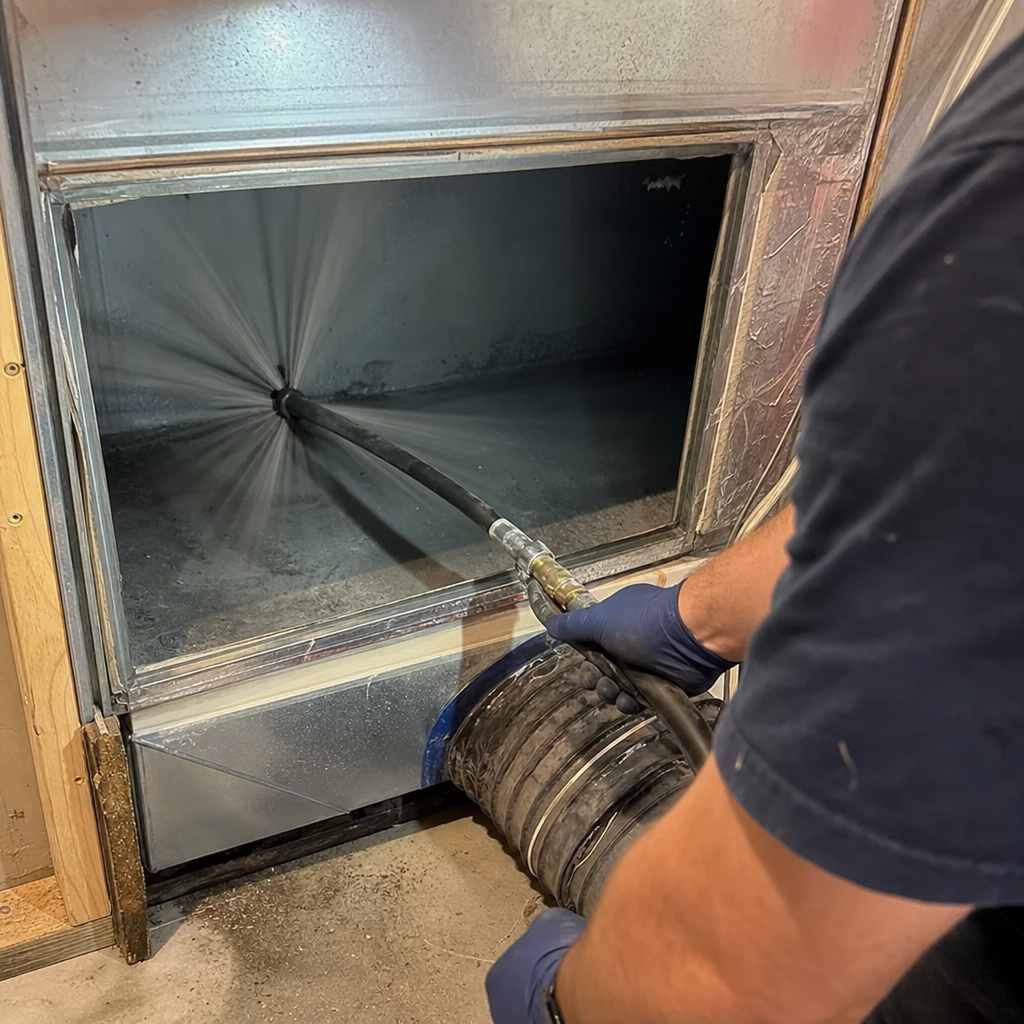
The dividing line is simple: if you can’t see the full extent of the problem from the register opening without tools, you probably can’t fully address it without tools either. Our Matrix Air Duct & Vent Cleaning Ohio home page outlines what professional-grade cleaning involves — rotary brush systems like our Rotobrush equipment, HEPA-contained vacuums, and access protocols that don’t damage your finishes.
One Columbus-specific note: homes in the 43201 and 43202 ZIP codes, near Ohio State’s main campus, often have been converted to rental units with decades of deferred maintenance. If you’re a new owner in these areas, assume any finding warrants professional assessment until proven otherwise.
Deep Maintenance Tasks Between Professional Cleanings
Even with annual professional service, these tasks extend system cleanliness and catch developing issues.
Quarterly: Return Air Path Inspection
Your return grille pulls air from your living space — and everything in it. In Columbus’s older homes with central returns (one large grille per floor rather than returns in each room), this single point concentrates loading.
- Remove the return grille and vacuum the cavity behind it with a brush attachment
- Check the filter track for gaps — even 1/4-inch bypass allows significant unfiltered airflow
- Verify your filter is oriented correctly (arrow pointing toward the furnace, not the room)
- Look for light leakage around the filter frame with a flashlight; any glow indicates bypass
Bi-Annually: Condensate Drain and Pan
Columbus’s cooling season humidity loads your evaporator coil’s condensate system. A clogged drain pan overflows into the duct plenum below it, creating a contamination source that circulates through your entire system.
- Locate your condensate drain line (typically PVC pipe near your indoor unit)
- Pour a cup of white vinegar through the access port to discourage algae
- Check the emergency pan beneath the unit if you have one — any water indicates primary drain blockage
As Needed: Register Grille Maintenance
Painted-over grilles, common in flipped Columbus properties, restrict airflow and trap debris. If your grilles have multiple paint layers, consider replacement — they’re inexpensive and proper airflow reduces system strain.
Clean ducts are only part of the picture. When our inspection finds issues beyond debris — disconnected ducts, deteriorated sealing, or microbial contamination — we discuss Air Duct Cleaning in Akron and our broader service options including Duct Repair & Sealing and Air Quality & Sanitizing. The owner is on the job for these assessments, not a commissioned salesperson.
Common Mistakes to Avoid
- Assuming a new filter means clean ducts. Filters capture only what passes through them. Leaky filter frames, bypassed return paths, and blower wheel contamination all introduce debris downstream of filtration. We’ve cleaned ducts in Columbus homes with religious filter-changers who were shocked at the internal buildup.
- Using “duct cleaning” attachments on household vacuums. These consumer products lack the HEPA containment and rotary mechanical action to dislodge adhered debris. Worse, they often damage flex duct or dislodge connections in older systems. German Village’s tight construction and finished basements make access repairs particularly expensive.
- Ignoring seasonal timing. Scheduling duct cleaning in peak summer or winter means your system is down when you need it most. Columbus’s shoulder seasons — April-May and September-October — offer comfortable temperatures for system downtime and position cleaning before heavy-use periods.
- Checking only supply registers. Returns are the intake — they’re where debris enters the system. A clean supply register with a contaminated return is like polishing your car’s exhaust pipe. Our HVAC Cleaning in Akron service addresses both sides of the airflow loop.
- Waiting for visible dust at registers. By the time debris reaches your supply registers, it’s already circulated through your system multiple times. The boot inspection we described earlier catches problems upstream of this endpoint.
- Neglecting dryer vent coordination. Your dryer vent is part of your home’s air management system. Lint accumulation restricts airflow and creates fire risk. Our Dryer Vent Cleaning in Akron service often reveals vent configurations that contribute to overall household air pressure imbalances affecting duct performance.
- Treating all duct materials the same. Columbus homes span decades of construction — galvanized steel, aluminum flex, fiberglass duct board, and modern PVC. Each requires different inspection emphasis: flex duct for kinks and disconnections, fiberglass for internal liner degradation, metal for rust and sealant failure.
When to Call a Professional
Some findings on your checklist are unambiguous signals for professional assessment. Call when you observe: visible mold on any duct surface; debris beyond arm’s reach from any register; persistent musty or chemical odors after system cycling; temperature variation greater than 5°F between rooms; unexplained increase in dust accumulation on surfaces; or respiratory symptoms that worsen when the system runs.
After 11 years focused on one trade, we’ve learned that Columbus homeowners who maintain this checklist typically extend their professional cleaning interval from every 3-4 years to every 5-7 years — but only when they’re honest about what they find. The $49 coupon companies won’t tell you this: superficial vacuuming of accessible register areas doesn’t address trunk line buildup, and in some cases disturbs debris without removing it.
Matrix Air Duct & Vent Cleaning Ohio offers free estimates in Columbus — call (833) 991-6689. Joseph Taylor, the owner, is on the job for every assessment, and we carry professional-grade equipment from Rotobrush, Nikro, and Abatement Technologies — the same brands specified in commercial IAQ contracts. See what 227 customers say about our work.
Frequently Asked Questions
Most Columbus homes benefit from professional air duct cleaning every 5 to 7 years with consistent filter maintenance and the inspection routine described above. Homes with pets, recent renovations, or occupants with respiratory sensitivities may need service every 3 to 4 years. Call (833) 991-6689 for an assessment of your specific system condition — estimates are free.
Professional whole-system cleaning in the Columbus market typically ranges from $400 to $800 for a standard single-family home, depending on system size, accessibility, and contamination level. Be wary of offers below $300 — they rarely include trunk line cleaning or use proper containment equipment. We provide upfront pricing after inspection, not bait-and-switch phone quotes.
Surface cleaning of register grilles and visible boot areas is appropriate DIY maintenance, but trunk line and main plenum cleaning requires rotary mechanical agitation and negative air HEPA containment that household equipment cannot provide. Attempting deeper cleaning without proper tools risks damaging duct connections and dispersing contaminants into your living space.
Musty odors at AC startup typically indicate microbial growth on your evaporator coil, in the condensate pan, or on duct surfaces where summer humidity has accumulated condensation. Columbus’s July-August humidity creates ideal conditions for this. The smell often diminishes after a few minutes as the coil dries, but the underlying contamination remains and circulates. Professional cleaning with sanitizing treatment addresses the source, not just the symptom.
Telltale signs include: rooms that are consistently harder to heat or cool; dust accumulation around register edges; whistling or rushing sounds from duct cavities; and energy bills that increase without usage changes. In Columbus’s climate, winter heating season makes leaks most apparent — you’re paying to heat your attic or crawl space. Our Duct Repair & Sealing service uses pressure testing to quantify leakage before any work begins.
After — always. New furnaces have more efficient, often variable-speed blowers that will circulate any existing duct debris more aggressively than your old unit. Installing a clean system into dirty ducts undermines your investment and can void some manufacturer warranties. Coordinate with your HVAC contractor: we can schedule cleaning within a day or two of furnace installation to minimize downtime.
The Bottom Line
A duct cleaning maintenance checklist isn’t busywork — it’s early warning radar for your home’s most expensive mechanical system and the air your family breathes. The 20-minute register inspection, seasonal timing tied to Columbus’s climate, and simple airflow logging we’ve described take less collective time per year than changing a few light bulbs. Used consistently, these practices reduce professional service frequency, catch problems before they require costly repair, and give you factual basis for deciding when to call rather than guessing. For more tips, explore our blog. The homeowners we serve longest are the ones who treat their ducts as a monitored system, not an out-of-sight mystery.
Ready for a professional assessment? Call Matrix Air Duct & Vent Cleaning Ohio at (833) 991-6689 for a free estimate. Joseph Taylor serves as both owner and lead technician on every Columbus job, backed by 11 years of specialized experience and equipment from Rotobrush, Nikro, and Abatement Technologies.
Written by Joseph Taylor, Owner & Lead Technician at Matrix Air Duct & Vent Cleaning Ohio, serving Columbus since 2015.