
Last updated July 10, 2026
How to Hire a Air Duct Cleaning Contractor in Columbus: A Step-by-Step Guide
That $99 duct cleaning coupon in your Columbus mailbox? It exists because the business model depends on upselling you $400 in add-ons once the crew is already inside your house. After 11 years cleaning ducts across Franklin County — from Victorian Village to Grove City — we’ve learned that hiring the right contractor comes down to three questions that separate owner-operators who understand airflow from dispatched crews reading prompts off a tablet. This guide walks you through exactly what to ask, what answers to demand, and which red flags send you back to Google.
Quick Answer
To hire a reliable air duct cleaning contractor in Columbus, verify they carry real general liability insurance (ask for a certificate), confirm they use commercial-grade equipment with named brands and stated CFM ratings, and insist on an estimate that accounts for your home’s square footage, number of return vents, and HVAC system type. Avoid any company that quotes a flat rate without seeing your system or that sends subcontracted technicians rather than the owner or lead technician.
Table of Contents
- Why Low Quotes in Columbus Usually Fail
- Three Questions That Separate Real Technicians From Sales Crews
- Equipment Matters: What CFM Ratings and Brush Brands Actually Mean
- Ohio’s Licensing Gap and How to Verify Real Coverage
- Red Flags in the Estimate Process
- Owner-Operator vs. Franchise Crew: Why Accountability Differs
- What to Expect During the Job
- Common Mistakes to Avoid
- When to Call a Professional
- Frequently Asked Questions
- The Bottom Line
Why Low Quotes in Columbus Usually Fail
The Columbus market is saturated with $89–$129 duct cleaning offers, especially in suburban zip codes like Dublin, Westerville, and Reynoldsburg where direct mail still lands heavily. Here’s what those prices actually buy: a single technician with a shop vacuum, 45 minutes in your home, and a sales pitch for mold treatments, coil cleaning, and “sanitizing” you didn’t request.
We’ve serviced homes in Clintonville where the previous $99 cleaner never even accessed the main trunk line — just ran a brush through two visible vents and collected payment. In Bexley, a customer called us after a budget crew disconnected a flex duct in the attic and left without mentioning it. The homeowner discovered the issue months later when their upstairs bedroom wouldn’t heat.
Low-quote companies operate on volume, not thoroughness. Their technicians are often subcontractors paid per job, incentivized to complete four or five homes daily. That pace doesn’t allow for proper inspection, sealed containment, or post-cleaning verification. Columbus’s climate — humid summers that promote microbial growth in ductwork, plus winter heating seasons that recirculate accumulated dust — makes shortcuts especially costly for homeowners.
The honest math: a proper residential duct cleaning in Columbus, using commercial negative-air equipment and covering all supply and return branches, typically requires 2.5 to 4 hours for a 2,000-square-foot home. Anyone promising comprehensive service in under 90 minutes is cutting something.
Three Questions That Separate Real Technicians From Sales Crews
After a decade in this trade, we’ve found three questions that instantly reveal who’s legitimate and who’s operating a sales funnel disguised as a service company.
Question 1: “What’s the CFM rating of your vacuum equipment, and do you use negative air or contact cleaning?”
A technician who pauses or deflects doesn’t understand their own tools. Negative-air cleaning requires a vacuum generating 5,000+ CFM (cubic feet per minute) to create proper suction at the trunk line while agitation tools dislodge debris. Contact cleaning systems like Rotobrush operate at lower CFM but use mechanical brushing combined with vacuum — effective for residential systems when properly applied. Either answer is acceptable if specific. “We have powerful equipment” is not.
Question 2: “Will you inspect the entire system before quoting, and what does your estimate include?”
Legitimate contractors in Columbus need to know: square footage, number of supply and return vents, whether you have flex duct or hard pipe, and if your HVAC system includes accessible trunk lines. A quote given over the phone without this information is a fishing expedition. Our Matrix Air Duct & Vent Cleaning Ohio home estimates always begin with these specifics.
Question 3: “Who exactly will be in my home — the owner, an employee, or a subcontractor?”
This question exposes the franchise model. Many national brands operating in Columbus dispatch crews through third-party platforms; the person answering your call has never met the technician who arrives. When something goes wrong — damaged ductwork, missed connections, inadequate cleaning — accountability dissolves between the brand, the local franchisee, and the subcontractor.
Equipment Matters: What CFM Ratings and Brush Brands Actually Mean
Equipment transparency separates commercial-grade operators from residential pretenders. Here’s what to listen for:
| Equipment Type | What to Ask | Why It Matters |
|---|---|---|
| Negative-air vacuum | “What’s your CFM at the trunk?” | Residential units run 2,000–4,000 CFM; commercial systems 5,000–10,000+. Higher CFM prevents debris escaping during agitation. |
| Agitation system | “What brush or whip system do you use?” | Rotobrush systems use rotating brushes with vacuum integration; pneumatic whips (Nikro, Abatement Technologies brands) blast compressed air for hard pipe. Each suits different duct materials. |
| HEPA filtration | “Is your vacuum HEPA-filtered?” | Without HEPA, disturbed particles re-enter your home. Essential for allergy-sensitive households in Columbus’s pollen-heavy seasons. |
| Access tools | “How do you create duct access points?” | Proper access requires sealed ports, not hacked sheet metal. Poor access creation causes air leaks that undermine HVAC efficiency. |
We use Rotobrush systems for residential flex-duct applications and Abatement Technologies negative-air equipment for commercial and hard-pipe residential jobs in Columbus. The tool matches the job — anyone claiming one system handles everything hasn’t encountered the variety of ductwork installed across Columbus’s housing stock, from 1920s German Village brick homes to new construction in Powell with insulated flex runs.
Ohio’s Licensing Gap and How to Verify Real Coverage
Here’s a fact most Columbus homeowners don’t know: Ohio does not license air duct cleaning contractors. No state exam, no continuing education requirement, no regulatory board. Anyone with a vacuum and business cards can advertise the service.
This makes third-party verification essential. NADCA (National Air Duct Cleaners Association) certification indicates a company has met industry standards for cleaning methods and ethical practices — but it’s voluntary, not regulatory. EPA guidelines on duct cleaning exist but aren’t enforced by any Ohio agency.
What actually protects you is insurance. Request a certificate of insurance (COI) directly from the contractor’s insurance provider, not a PDF they email you. The COI should show:
- General liability coverage of at least $1 million per occurrence
- Specific coverage for work performed at residential properties
- Your address listed as certificate holder if the job is substantial
We’ve repaired ductwork in Upper Arlington where an uninsured cleaner damaged a main trunk line and simply disappeared. The homeowner’s claim against their own policy raised premiums for three years. In Hilliard, a technician without proper coverage fell through an attic ceiling — the homeowner faced liability exposure because the “company” was an unincorporated individual with no workers’ compensation.
Joseph Taylor carries full general liability and workers’ compensation coverage for every Columbus job. We provide COIs without hesitation because we’ve seen what happens when contractors don’t.
Red Flags in the Estimate Process
How a contractor prices reveals how they’ll perform. Watch for these specific warning signs:
- Flat-rate quoting without system details. A 1,200-square-foot condo with four vents and a 3,500-square-foot home with sixteen vents, two HVAC systems, and crawl space ductwork cannot cost the same to clean properly. Anyone quoting $149 “for any home” is planning to upsell or shortcut.
- Pressure for immediate booking. “This price expires tonight” or “We have one opening this week” are sales tactics, not service indicators. Legitimate Columbus contractors maintain schedules; they don’t create artificial scarcity.
- Vague scope descriptions. The estimate should specify: number of supply vents cleaned, number of return vents cleaned, trunk line access and cleaning, register removal and hand cleaning, and post-cleaning inspection method. “Whole house duct cleaning” means nothing without these details.
- Mandatory add-on framing. “We include sanitizing in every job” often masks a base price inflated beyond market rate. Sanitizing with EPA-registered products like Guardsman solutions has legitimate applications — after verified microbial contamination, or for immunocompromised households — but it’s not automatically necessary. Treat bundled sanitizing as a pricing red flag.
- No physical address or local verification. Search the company’s stated address. We’ve found “Columbus” duct cleaners operating from mailboxes in other states, dispatching crews through gig-economy platforms. A real local business has a real local presence.
Owner-Operator vs. Franchise Crew: Why Accountability Differs
The structural difference between these models affects everything from quote accuracy to dispute resolution.
Franchise/subcontractor model: A national brand sells territory rights. The franchisee hires technicians, often as 1099 subcontractors, through job boards or staffing apps. The technician who arrives may have been cleaning carpets last week and ducts this week. They follow tablet-based scripts, not accumulated expertise. When quality issues arise, the customer navigates between brand customer service (out of state), franchisee management (deflecting to “their vendor”), and the individual technician (often unresponsive).
Owner-operator model: The person who built the business performs the work. Joseph Taylor answers the phone, conducts the estimate, operates the equipment, and stands behind the result. In 11 years and 227 reviews averaging 4.8 stars, our accountability chain has one link.
This matters practically. When we find a disconnected duct in a New Albany attic, we repair it — we don’t note it and leave for the next appointment. When a German Village homeowner questions whether their 90-year-old plaster and lathe can accommodate modern access ports, we evaluate the structure and propose alternatives, not force a standardized approach. The owner on the job means decisions get made by someone with stake in the outcome, not someone paid hourly regardless.
For Columbus homeowners, this translates to consistent quality and direct recourse. Our Air Duct Cleaning in Akron and HVAC Cleaning in Akron operations follow the same owner-led model.
What to Expect During the Job
Understanding proper procedure helps you evaluate performance in real time. A thorough residential duct cleaning in Columbus should follow this sequence:
- Pre-inspection and documentation. The technician photographs vent conditions, notes system type, and identifies any access challenges. This takes 10–15 minutes and should happen before equipment enters your home.
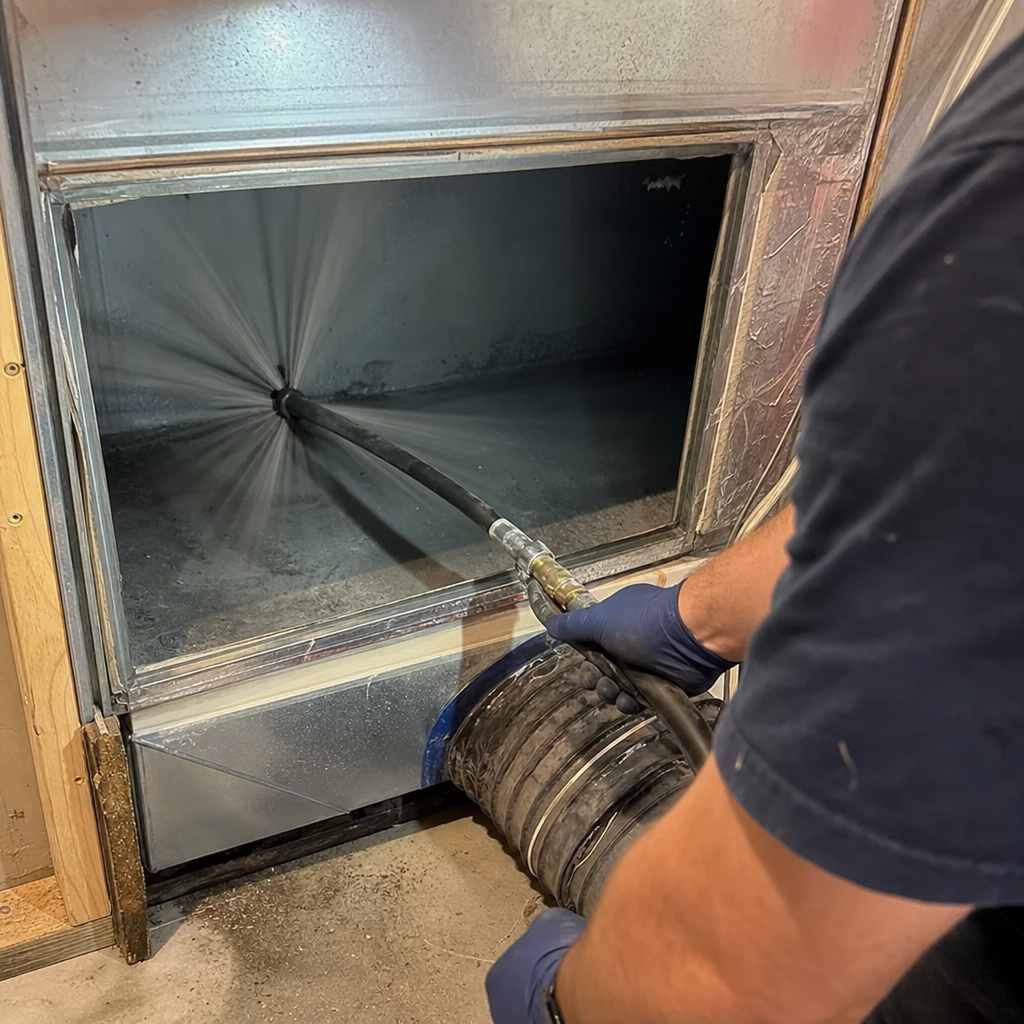
- Containment setup. Protective coverings on floors and furniture near work areas. HEPA-filtered negative air machine connected to trunk line, with sealed access ports preventing dust migration.
- Register removal and manual cleaning. Vent covers come off for individual washing — not just vacuuming in place. This catches the grime layer that adheres to metal and plastic surfaces.
- Mechanical agitation of duct runs. Rotobrush or pneumatic tools traverse each supply and return branch, dislodging accumulated debris. Multiple passes are normal; single passes are insufficient.
- Trunk line cleaning. The main distribution channels receive dedicated attention, often through additional access points that are properly sealed afterward.
- Post-cleaning verification. Visual inspection, photography comparison, and airflow testing confirm results. The technician should show you before/after images and explain any findings — damaged ducts, improper original installation, areas requiring repair or sealing.
Total time: 2.5–4 hours for typical Columbus homes, longer for larger properties or systems with accessibility complications. Anyone finishing in 60–90 minutes has skipped steps.
Common Mistakes to Avoid
- Booking based on coupon price alone. In Columbus’s competitive market, the lowest initial quote often produces the highest final invoice through aggressive upselling. Compare scope, not headline price.
- Ignoring seasonal timing. Columbus’s peak pollen seasons (April–May, September) and heavy heating months (December–February) create demand surges. Schedule shoulder seasons for better technician availability and more thorough attention.
- Assuming all “certifications” are equal. NADCA membership has value; random “certified duct cleaner” badges from online courses do not. Verify certification sources.
- Neglecting dryer vent inspection. Clogged dryer vents cause more residential fires in Ohio than any other HVAC-related hazard. Our Dryer Vent Cleaning in Akron service addresses this specifically — Columbus homeowners should ensure their duct cleaner inspects this critical component or schedule dedicated service.
- Accepting verbal warranties. “Satisfaction guaranteed” means nothing without written terms. Request specific recourse language: re-cleaning, refund conditions, damage liability.
- Forgetting to check review patterns. 227 reviews averaging 4.8 stars over years indicates consistent performance; 15 five-star reviews clustered in one month suggests a promotional push or review solicitation.
- Treating cleaning as the endpoint. Clean ducts are only part of the picture. Leaky ductwork in unconditioned spaces — common in Columbus’s many ranch homes with crawl space or attic runs — wastes the cleaning investment. Ask whether your contractor evaluates and can address duct sealing needs.
When to Call a Professional
Schedule professional evaluation when you notice visible dust emission from vents, inconsistent airflow between rooms, musty odors when HVAC cycles on, or after any renovation work that generated construction dust. In Columbus’s older neighborhoods like Merion Village and Old Oaks, homes with original ductwork often benefit from inspection even without obvious symptoms — decades of accumulated debris and deteriorating flex connections aren’t always visible.
Post-renovation cleaning is particularly important given Columbus’s active historic renovation market. Lead paint remediation, plaster work, and flooring replacement all generate fine particulates that standard filtration misses.
Matrix Air Duct & Vent Cleaning Ohio offers free estimates in Columbus — call (833) 991-6689. Joseph Taylor conducts each evaluation personally, and we’ll tell you honestly if your system doesn’t need service.
Frequently Asked Questions
Proper residential duct cleaning in Columbus typically ranges from $350 to $700 depending on home size, vent count, and system accessibility. Single-system homes under 2,000 square feet with standard vent configurations generally fall at the lower end; larger homes, multiple HVAC systems, or crawl space/attic ductwork requiring additional access push costs higher. Call (833) 991-6689 for a free estimate based on your specific Columbus home — we price by scope, not square footage alone.
Every 3 to 5 years for typical households, more frequently for homes with pets, smokers, recent renovations, or residents with respiratory conditions. Columbus’s combination of humid summers and active pollen seasons accelerates accumulation compared to drier climates. Homes near construction zones or major roadways like I-270 or Route 315 may need more frequent service due to particulate loading.
No — Ohio does not require any certification for air duct cleaning contractors. NADCA membership is voluntary but indicates adherence to industry cleaning standards and ethical practices. Since no state agency verifies duct cleaners, NADCA certification and verified insurance become your primary quality indicators. Ask to see current membership documentation.
Poorly executed cleaning can damage flex duct, dislodge connections, or compromise seals — which is why equipment knowledge and technician experience matter. We’ve repaired damage in Columbus homes caused by aggressive rotary brushes in fragile flex duct or unsealed access points creating air leaks. Professional-grade equipment operated by trained technicians minimizes this risk; bargain operators increase it.
Cleaning removes physical debris — dust, pet dander, construction particulate. Sanitizing applies EPA-registered antimicrobial agents to address microbial contamination. Sanitizing is appropriate when testing confirms mold or bacterial presence, or for specific health-sensitive situations, but it’s not automatically necessary with every cleaning. We use Guardsman and other registered products when conditions warrant, not as a default upsell.
Verify their business address through Ohio Secretary of State filings, check for local phone numbers (614 area code), and search reviews for Columbus-specific neighborhood mentions. Ask directly: “What’s your physical address, and do you dispatch from that location?” National lead-generation sites often use local phone numbers while routing calls to out-of-state call centers.
The Bottom Line
Hiring an air duct cleaning contractor in Columbus requires looking past price to structure: insurance you can verify, equipment you can name, and accountability you can trace to a specific person. The three questions — CFM and method, estimate specificity, and who performs the work — separate legitimate operators from coupon-driven sales operations. In a state with no licensing requirement, your diligence is your protection. Joseph Taylor has built Matrix Air Duct & Vent Cleaning Ohio on transparency about these exact standards, because 11 years in this trade has shown what happens when homeowners don’t know to ask.
Ready for an honest evaluation of your Columbus home’s ductwork? Call (833) 991-6689 for a free estimate. Joseph Taylor answers directly, and the owner is on the job.
Written by Joseph Taylor, Owner & Lead Technician at Matrix Air Duct & Vent Cleaning Ohio, serving Columbus since 2015.