
Last updated September 3, 2026
Air Duct Cleaning Permits, Codes & Inspections in OH: What You Need to Know
Here’s the scenario we run into almost weekly in Columbus: a homeowner hires a duct cleaning crew, they find a disconnected trunk line in the basement, and they “fix it” on the spot as part of Air Duct Cleaning services. No permit. No inspection. No documentation. Six months later, that house is under contract, the buyer’s inspector flags the repair, and the seller is scrambling to pull a retroactive mechanical permit — often costing $400–$800 in fees, re-inspections, and contractor callbacks. In Franklin County, we’ve seen this exact pattern derail closings in Clintonville, Bexley, and the Short North. The truth most Ohio homeowners don’t realize: air duct cleaning itself lives in a regulatory gray area, but the moment a contractor crosses into repair, modification, or sealant application, they’re playing in a completely different rulebook — one with real consequences for your property value and insurance coverage.
Quick Answer
Air duct cleaning alone — the mechanical removal of dust and debris from existing ductwork — does not require a permit anywhere in Ohio, as explained in The Complete Guide to Air Duct Cleaning in Columbus. However, if a contractor seals a breach, replaces a section of flex duct, applies antimicrobial coatings, or modifies the HVAC system’s airflow design, Ohio Mechanical Code treats that work as a mechanical alteration requiring a permit from your local building department. In Columbus and Franklin County, unpermitted duct modifications are increasingly flagged during real estate inspections, with retroactive permitting costs typically falling on the homeowner.
Table of Contents
- Where Ohio Draws the Line: Cleaning vs. Repair
- How Columbus and Franklin County Interpret the Code
- Antimicrobials, Sealants, and EPA Requirements
- The Home Sale Nightmare: Unpermitted Work Surfaces
- 5 Questions to Ask Before a Contractor Touches Your Ducts
- What Home Inspectors Actually Look For
- Common Mistakes to Avoid
- When to Call a Professional
- Frequently Asked Questions
Where Ohio Draws the Line: Cleaning vs. Repair
Ohio’s regulatory framework for HVAC work sits at the intersection of state mechanical code and local enforcement. Understanding where the boundary falls protects you from both unqualified contractors and expensive surprises down the road.
Cleaning: No Permit Required
Pure air duct cleaning — using brushes, compressed air, and negative pressure vacuum systems to remove accumulated debris — falls outside Ohio Mechanical Code’s permit triggers. The Ohio Board of Building Standards, which governs the statewide mechanical code, defines permit-triggering work as “installation, alteration, repair, or replacement” of mechanical systems. Cleaning, by their interpretation, constitutes maintenance rather than modification.
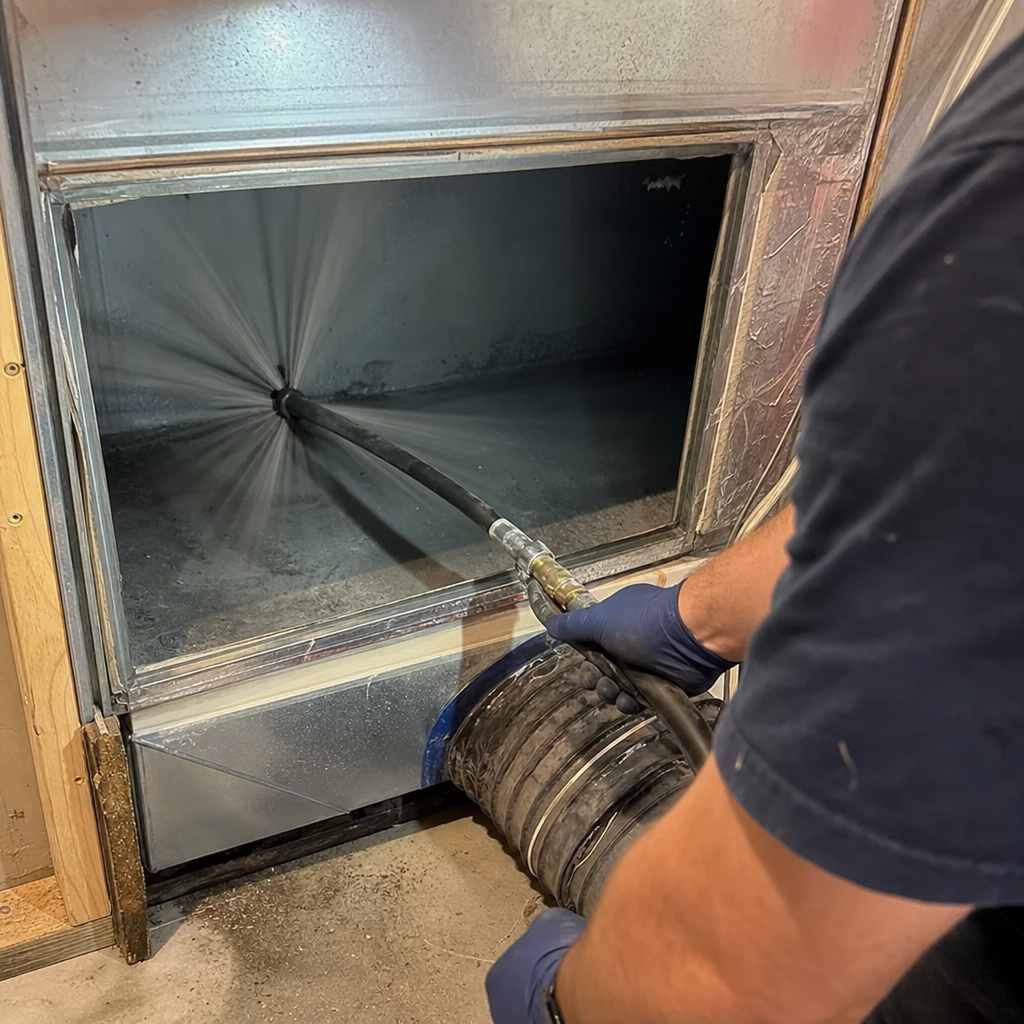
We’ve spent 11 years in Columbus homes using Rotobrush and Nikro equipment to extract dust, construction debris, and pet dander from duct systems. That work — when it stops at cleaning — generates no permit obligation. The ducts look the same when we leave, just empty of contaminants.
Repair and Modification: Permit Required
The line crosses the moment a contractor changes the system’s physical structure or airflow characteristics. Under Ohio Mechanical Code Section 108, the following trigger permit requirements:
- Sealing breaches or disconnected joints — Reconnecting a fallen flex duct or sealing a gap with mastic changes the system’s engineered airflow
- Replacing duct sections — Even matching like-for-like flex duct constitutes “repair” under code definitions
- Modifying trunk lines or takeoffs — Adding, removing, or relocating supply or return openings
- Applying internal sealants or liners — Products like Aeroseal or spray-applied coatings alter the duct’s internal surface and pressure characteristics
- Installing access panels — Cutting into ductwork to create cleaning ports, if not done with proper closure methods
In our Columbus work, we regularly encounter systems where previous “cleaning” crews have crossed this line. A common scenario in older homes near German Village or Victorian Village: a contractor finds a collapsed flex duct in the attic, replaces it without documentation, and the homeowner has no idea they’ve received unpermitted mechanical work. When we find these situations during our assessments, we flag them and recommend proper permitting before any further modification.
The Gray Zone: What’s Actually Enforced
Here’s where Ohio gets complicated. State code sets the floor, but local jurisdictions determine enforcement intensity. For more, see How to Hire a Air Duct Cleaning Contractor in Columbus: A Step-by-Step Guide. Columbus Building and Zoning Services has, since 2019, increased mechanical permit scrutiny in response to a wave of unpermitted HVAC modifications discovered during post-sale disputes. Surrounding municipalities — Dublin, Westerville, Reynoldsburg — vary in their inspection bandwidth, but all follow the same underlying code framework.
How Columbus and Franklin County Interpret the Code
Not all Ohio municipalities handle duct work the same way. In our 11 years serving the Columbus metro, we’ve navigated enough jurisdictions to map the practical differences.
Columbus: Heightened Scrutiny Post-2019
Columbus Building and Zoning Services maintains a mechanical permit requirement for any duct repair or modification, with inspection required before closure. The city’s 2019 policy update — driven by a spike in homeowner complaints about unpermitted HVAC work — added specific language about duct sealing and flex duct replacement.
Practical impact: If you’re in Columbus proper — from Linden to Merion Village to Far East — any contractor performing duct repair must pull a mechanical permit ($150–$300 depending on project scope) and schedule inspection. The city inspector verifies proper materials (UL 181-rated flex duct, approved mastic or tape), adequate support straps, and correct sizing for the system’s CFM requirements.
Franklin County Townships: Variable Enforcement
Unincorporated Franklin County and township jurisdictions (Blendon, Jefferson, Plain) typically defer to state code but with lighter inspection staffing. Permit requirements exist on paper; enforcement depends on whether the work gets flagged — usually through a home sale inspection or insurance claim.
Surrounding Counties: Dublin, Westerville, Reynoldsburg Patterns
We’ve observed a clear pattern: suburban municipalities with active building departments (Dublin, Westerville, Powell) enforce mechanical permits more consistently than cash-strapped rural townships. Delaware County, where we’ve worked in homes near Polaris, has streamlined online permitting that’s actually easier to navigate than Columbus’s system — but the requirement is identical.
| Jurisdiction | Permit Required for Duct Repair? | Typical Permit Fee | Inspection Timeline |
|---|---|---|---|
| Columbus (city limits) | Yes — mechanical permit | $150–$300 | 2–5 business days |
| Franklin County (unincorporated) | Yes — state code applies | $100–$200 | Variable; often 1–2 weeks |
| Dublin | Yes — active enforcement | $125–$250 | 3–5 business days |
| Westerville | Yes — active enforcement | $125–$250 | 3–5 business days |
| Delaware County | Yes — streamlined process | $100–$200 | 2–4 business days |
The critical takeaway: code uniformity doesn’t equal enforcement uniformity. A contractor working in rural Licking County faces less immediate inspection pressure than one in Columbus, but the underlying permit obligation is identical — and unpermitted work surfaces eventually, typically at the worst possible moment for the homeowner.
Antimicrobials, Sealants, and EPA Requirements
This section covers territory most duct cleaning competitors in Columbus never address — and it’s where homeowners unknowingly accept liability. For more guides & resources, visit our blog.
EPA Registration: The Non-Negotiable Requirement
Any antimicrobial treatment applied inside ductwork must use an EPA-registered product specifically labeled for HVAC use. This isn’t a guideline — it’s federal law under FIFRA (Federal Insecticide, Fungicide, and Rodenticide Act). The product label dictates approved application sites, concentration, and dwell time.
In our work, we use Guardsman-registered sanitizing protocols when customers request antimicrobial treatment after cleaning. We maintain SDS sheets and application records for every treatment. Here’s what Ohio homeowners should verify:
- EPA registration number — Must appear on the product label; verify at epa.gov
- HVAC-specific labeling — “General disinfectant” registration isn’t sufficient; the label must explicitly list HVAC duct interiors as an approved site
- Application method compliance — Fogging, spraying, or coating must match the label’s prescribed method
- Post-application ventilation — Label-specified re-entry and system-run times before occupancy
Ohio Disclosure Requirements
Ohio Revised Code 5302.30 requires sellers to disclose “material defects” including environmental hazards. While antimicrobial application isn’t inherently a defect, unregistered chemical application or off-label use could trigger disclosure obligations if health effects emerge. We’ve consulted with Columbus real estate attorneys who’ve seen this surface in transactions where buyers experienced respiratory symptoms post-purchase and traced them to unverified duct treatments.
Sealants and Internal Coatings: The Hidden Permit Trigger
Products like Aeroseal — which seal duct leaks from the interior through aerosolized polymer deposition — constitute both modification and coating application. They require:
- Mechanical permit (alteration of system airflow characteristics)
- EPA compliance review (polymer composition and VOC emissions)
- Post-application pressure testing (to verify seal effectiveness and system integrity)
We’ve declined to offer aerosol sealant services specifically because the permitting complexity exceeds what most residential customers expect from a duct cleaning engagement. When Columbus customers need sealing, we perform manual duct repair and sealing with mechanical permits — a more transparent, documentable process.
The Home Sale Nightmare: Unpermitted Work Surfaces
This is where abstract code requirements become concrete financial pain. In Columbus’s active real estate market — particularly in competitive neighborhoods like Clintonville, Grandview Heights, and the Short North — unpermitted duct modifications are increasingly deal-killers.
How It Gets Discovered
Home inspectors in the Columbus Association of Real Estate Inspectors (CAREI) have, since 2021, increasingly flagged ductwork modifications lacking permit documentation. Common discovery paths:
- Visual inconsistency — New flex duct spliced into old galvanized trunk line, with no permit history on file
- Label mismatch — Duct materials bearing manufacture dates after the home’s last permitted mechanical work
- Performance anomaly — Room airflow imbalances that suggest unauthorized takeoff modifications
- Seller disclosure gap — Previous owner mentions “duct work” with no permit documentation
The Remediation Cost Cascade
When unpermitted duct work surfaces during a Columbus home sale, the typical resolution path runs:
- Buyer’s lender or insurer demands permit documentation
- Seller contacts original contractor — often out of business or unresponsive
- Local building department requires retroactive permit application ($200–$400)
- Licensed contractor must inspect and certify work meets current code — often revealing deficiencies requiring rework ($500–$2,000)
- Re-inspection required before clearance letter issued
- Closing delayed 2–6 weeks; in competitive markets, buyer may walk
We’ve been called into these situations in Bexley and Upper Arlington — homeowners who thought they were getting a simple duct cleaning, ended up with unpermitted “repair,” and are now paying us to properly permit and document work that should have been done correctly the first time.
Insurance Complications
Homeowners insurance policies increasingly contain exclusions for “unpermitted modifications.” If a duct-related fire or water damage claim traces to unpermitted work, coverage denial is a real risk. In 2023, we consulted on a Columbus claim where an insurer denied $18,000 in water damage because a flex duct replacement — performed during a “cleaning” visit — lacked proper slope and condensate drainage, contributing to a pan overflow. The contractor had vanished; the homeowner absorbed the loss.
5 Questions to Ask Before a Contractor Touches Your Ducts
Based on 11 years of seeing what goes wrong, here are the specific questions that separate legitimate operators from permit-evaders:
- “Will you pull a mechanical permit if you find anything that needs repair?” — A “no” or “we’ll see” means they’re prepared to work outside legal scope. A qualified contractor has a permit process ready.
- “What specific products do you use for antimicrobial treatment, and what’s their EPA registration number?” — Legitimate operators know this immediately and provide documentation. Vague answers about “our special sanitizer” are red flags.
- “Will you document in writing what work was cleaning-only versus modification?” — This creates a paper trail protecting you if questions arise later. We provide this on every Columbus job.
- “What’s your process if you find disconnected ductwork during cleaning?” — The correct answer: stop, photograph, explain options including proper permitting, and let the homeowner decide. The dangerous answer: “We’ll just fix it quick, no extra charge.”
- “Can you show me your general liability and workers compensation certificates?” — No specific policy numbers needed, but confirmation of coverage protects you if a worker is injured on your property or damage occurs.
At Matrix Air Duct & Vent Cleaning Ohio home, Joseph Taylor handles these conversations directly — because he’s the one who’ll be on your job, not a subcontractor reading from a script.
What Home Inspectors Actually Look For
Understanding inspector priorities helps you anticipate problems and verify contractor quality. In Columbus and Franklin County, we’ve built relationships with inspectors and know their consistent focus areas.
Material Compliance
Inspectors verify duct materials match code requirements: UL 181-rated flex duct (not generic “ducting” from hardware stores), proper gauge metal for rigid sections, and approved fastening methods. We’ve found competitor “repairs” in Linden and Hilliard using dryer vent flex — entirely wrong material for HVAC pressure and temperature — that would fail inspection instantly.
Support and Slope
Flex duct must be supported at intervals specified by manufacturer and code — typically every 4 feet, with maximum sag of 1/2 inch per foot. Condensate-bearing lines require proper slope toward drains. These are details that rushed, unpermitted work routinely misses.
Return Air Integrity
Inspectors increasingly check that return air pathways are intact — not pulling from wall cavities, attics, or crawl spaces. Unpermitted “cleaning access” cuts that aren’t properly sealed create return leaks that violate code and degrade efficiency.
Documentation Chain
The simplest inspector check: “Show me the permit.” No permit means no inspection, which means no verification that any of the above was done correctly. In Columbus’s 2023 market, we’ve seen this single question torpedo three transactions we were called to remediate.
Common Mistakes to Avoid
- Assuming “cleaning” covers everything — In Columbus, we’ve seen homeowners pay for “complete duct restoration” that included unpermitted flex replacement and sealing. Get explicit scope documentation in writing.
- Accepting verbal permit assurances — A contractor saying “I’ll take care of it” without showing you the permit application or inspection schedule is avoiding accountability. In Franklin County, legitimate permits are trackable online.
- Ignoring antimicrobial product verification — That “hospital-grade disinfectant” fogged through your ducts may be an unregistered general cleaner. Demand EPA registration numbers and verify them.
- Letting sellers’ unpermitted work become your problem — In competitive Columbus markets, buyers waive inspections and inherit undocumented modifications. Always verify permit history for any duct work mentioned in disclosures.
- Hiring based on lowest duct cleaning price — The $89 whole-house specials often recover margin by upselling unpermitted “repairs” with no overhead for proper documentation. See what 227 customers say about the difference owner-operated expertise makes.
- Confusing equipment brands with contractor qualification — A Rotobrush machine doesn’t make an operator competent; 11 years focused on one trade does. Verify experience, not just tool inventory.
- Neglecting post-cleaning documentation — Photos of before/after condition, written scope, and any product labels used protect you in future transactions. We provide this standard.
When to Call a Professional
Certain scenarios demand immediate professional assessment — and the right professional matters.
Call for evaluation if you notice uneven heating or cooling across rooms, visible dust expulsion from supply vents, musty odors when HVAC runs, or if your home has undergone renovation without duct protection. In Columbus’s variable climate — humid summers that foster microbial growth, cold winters that stress system joints — these symptoms often indicate underlying issues beyond what DIY cleaning addresses.
More critically, call before any home sale if you know duct work was performed without permits. Proactive remediation costs far less than transaction-delay emergency fixes. We’ve guided Columbus homeowners through this process, coordinating with building departments and inspectors to clear title issues before listing.
Air Duct Cleaning in Akron and throughout our Ohio service area follows the same principles — owner-operated expertise, documented processes, and no shortcuts around code requirements. Dryer Vent Cleaning in Akron and HVAC Cleaning in Akron complete our full indoor air quality scope. Clean ducts are only part of the picture — when repair, sealing, or sanitizing is needed, we handle it with proper permits and accountability.
Matrix Air Duct & Vent Cleaning Ohio offers free estimates in Columbus — call (833) 991-6689. Joseph Taylor personally assesses every job, and if we find conditions requiring permitted work, we’ll explain exactly what’s needed, what it costs, and how we’ll document it properly.
Frequently Asked Questions
No — pure air duct cleaning, defined as mechanical debris removal without system modification, requires no permit in Columbus or anywhere in Ohio. The moment a contractor repairs, replaces, or seals duct components, Ohio Mechanical Code requires a mechanical permit. If you’re unsure where your project falls, call (833) 991-6689 for a free scope assessment.
Retroactive permits typically run $200–$500 in Franklin County, including original permit fees, penalties, and re-inspection costs. If rework is required to meet current code, total costs can reach $1,500–$3,000. Columbus’s building department has specific procedures for voluntary disclosure of unpermitted work that may reduce penalties — call them directly at (614) 645-7433 for current guidance.
No — any duct repair or modification without proper permitting violates Ohio Mechanical Code Section 108. Some contractors do it anyway, gambling that enforcement won’t catch up. That gamble becomes the homeowner’s problem during sale or insurance claims. Always verify permit status before work begins.
Look for an EPA registration number beginning with a four-digit company ID, followed by product-specific digits, with explicit HVAC duct interior listed as an approved application site. The label should specify method (fog, spray, coating), concentration, and post-application ventilation requirements. We maintain current Guardsman product registrations and provide labels on request.
Columbus permits are searchable at columbus.gov/buildingzoning. Franklin County permits are at auditor.franklinohio.gov. For surrounding jurisdictions, contact the specific building department. If you find no permit record for described work, assume it was unpermitted and consider proactive remediation before sale.
The “cheap” combined approach often costs more long-term. Unpermitted repair bundled into cleaning avoids upfront permit fees but creates sale/insurance risks that dwarf those savings. Properly permitted repair during a cleaning visit — what we do when conditions require it — adds permit costs ($150–$300) but protects your property value. Call (833) 991-6689 for exact pricing based on your specific system.
The Bottom Line
Ohio’s mechanical code creates a clear framework: cleaning is maintenance, repair is modification, and modification demands permits. The gap between these categories is where unscrupulous operators exploit homeowner trust — and where Columbus property owners discover hidden costs years later. In 11 years of focused duct and HVAC work, we’ve learned that documentation and transparency aren’t bureaucratic burdens; they’re the proof of quality that protects your investment. Whether you’re maintaining your current home or preparing for sale, know exactly what work is being performed, demand written scope and permit compliance, and choose operators who put their name and reputation on every job — not anonymous crews dispatched from a call center.
Written by Joseph Taylor, Owner & Lead Technician at Matrix Air Duct & Vent Cleaning Ohio, serving Columbus since 2015.