
Last updated September 3, 2026
The Complete Guide to Air Duct Cleaning in Columbus
After inspecting thousands of duct systems across Ohio, the single most common finding isn’t dust — it’s a previous “cleaning” that left debris packed into every elbow and boot because the crew used undersized residential vacuums. In Columbus, where clay-heavy soil generates fine particulates and humid summers create ideal conditions for microbial growth, a superficial duct cleaning isn’t just ineffective — it can make your indoor air quality worse by dislodging contaminants without fully removing them. This guide draws on 11 years of opening up real duct systems to show exactly what a thorough job looks like, start to finish. You’ll learn how Columbus’s specific climate and housing stock affect your ducts, how to tell professional equipment from shop-vac setups, and how to verify the work was actually done.
Quick Answer
Professional Air Duct Cleaning services in Columbus typically takes 3–5 hours for a single-family home and costs $300–$600 depending on system size and contamination level. A legitimate job uses truck-mounted or portable negative pressure systems (like Nikro or Abatement Technologies units) combined with mechanical agitation to extract debris at the source — not just blow it around. In Columbus’s humid climate and older housing stock, thorough cleaning should include inspection of fiberglass-lined ductwork and flexible duct connections common in 1950s–1980s builds.
Table of Contents
- What Columbus Homes Are Actually Breathing
- Professional-Grade Cleaning vs. Basic Suction: What the Equipment Reveals
- Source-Removal Cleaning vs. “Push-and-Pray” Methods
- Why Columbus’s Older Housing Stock Demands a Different Approach
- What a Thorough Job Looks Like: Step by Step
- How to Verify the Job Was Actually Done
- Common Mistakes to Avoid
- When to Call a Professional
- Frequently Asked Questions
What Columbus Homes Are Actually Breathing
Columbus sits on some of the most clay-dense soil in Ohio, and that geology directly affects what circulates through your ducts. When soil dries, it fractures into ultra-fine particulates — particles smaller than 2.5 microns that standard furnace filters don’t catch effectively. We’ve pulled accumulation from ductwork in Clintonville, Bexley, and Upper Arlington that looked like gray talcum powder packed against the duct walls. This isn’t ordinary household dust; it’s mineral-heavy, abrasive, and particularly stubborn once it settles into fiberglass duct liner or flexible duct connections.
The summer humidity in Columbus compounds the problem. From June through September, outdoor relative humidity regularly pushes 70–80%, and that moisture migrates into duct systems through return air pathways and small leaks. When fine clay particulates absorb this moisture, they create a paste-like layer that basic vacuuming won’t dislodge. Worse, that damp environment supports mold and bacterial growth on organic debris — pet dander, pollen, skin cells — that would otherwise remain dormant.
We’ve documented this pattern repeatedly in Columbus’s 1960s and 1970s ranch homes, where original fiberglass-lined ductwork runs through crawl spaces or slab perimeters. The combination of ground moisture wicking upward and clay particulates settling downward creates a contamination profile we don’t see in drier climates or sandier soil regions. A technician who treats Columbus ductwork like Phoenix ductwork — dry, sandy, minimal microbial concern — will miss the actual problem entirely.
Key indicators your Columbus home has this specific debris profile:
- Gray or tan streaking at supply register edges, especially on lower-level vents
- Musty odor amplification when the AC first cycles on in humid weather
- Uneven dust accumulation — heavy near returns, surprisingly light at distant supplies (indicates packed elbows, not clean ducts)
- Filter clogging every 3–4 weeks during dry late-summer periods when clay soil fractures
Professional-Grade Cleaning vs. Basic Suction: What the Equipment Reveals
The equipment a technician rolls into your home tells you everything about what your ducts will look like afterward. We’ve arrived at Columbus homes where the homeowner showed us photos from a previous service — a technician with a compact shop vacuum and a compressed-air wand, in and out in 45 minutes. Those systems invariably needed complete re-cleaning, and often the “cleaning” had packed debris deeper into the system.
Professional-grade negative pressure cleaning requires specific equipment categories that most residential franchise crews don’t carry:
- High-volume negative pressure source: Nikro portable HEPA vacuums or truck-mounted systems pulling 5,000+ CFM. This creates suction strong enough that debris moves through the entire duct run toward the collection point, rather than settling at the first elbow.
- Mechanical agitation tools: Rotobrush systems with rotating bristle heads that contact duct walls directly, dislodging adhered particulates that air pressure alone won’t move. In Columbus’s clay-heavy accumulation, this mechanical contact is essential — air wands simply glaze the surface.
- HEPA filtration on exhaust: Abatement Technologies HEPA negative air machines ensure that everything extracted stays extracted. Without true HEPA final filtration, fine particulates exhaust back into your living space or the technician’s workspace.
- Compressed air tools with controlled pressure: Not random “blow guns,” but calibrated skipper balls and whips that move debris toward the collection point without damaging flexible duct or dislodging connections.
The difference shows in what we find during post-cleaning inspection. After a professional-grade job with Nikro negative pressure and Rotobrush agitation, a borescope camera shows bare metal or clean fiberglass liner. After a basic suction pass, that same camera reveals packed debris in every horizontal run and boot connection — the places where gravity and low suction conspire to leave material behind.
In Columbus’s market, we’ve noticed a particular gap: many services advertise “Rotobrush cleaning” but deploy single-unit portable vacuums without adequate CFM for whole-system negative pressure. The brush spins, but there’s insufficient suction to transport dislodged debris out of the system. The result is a duct run that looks brushed but is actually loaded with loosened, more easily airborne contamination.
Source-Removal Cleaning vs. “Push-and-Pray” Methods
Source removal is the NADCA-certified standard: every contaminant leaves the building, captured at the point of extraction. “Push-and-pray” is what we call everything else — methods that move debris around, push it deeper, or simply stir it up without complete extraction.
We’ve developed this distinction from 11 years of opening systems after other services. In a source-removal job on a typical Columbus split-level with basement and main-floor returns, here’s what happens:
- System isolation and protection: The furnace and coil are sealed off. We don’t want debris migrating into equipment that wasn’t designed to filter construction-grade contamination.
- Access creation: Strategic openings at supply and return trunk lines, sized for agitation tool insertion and vacuum connection. In older Columbus homes with galvanized steel ductwork, this means cutting precise access panels that we seal with mechanical fasteners afterward — not tape that will fail in three years.
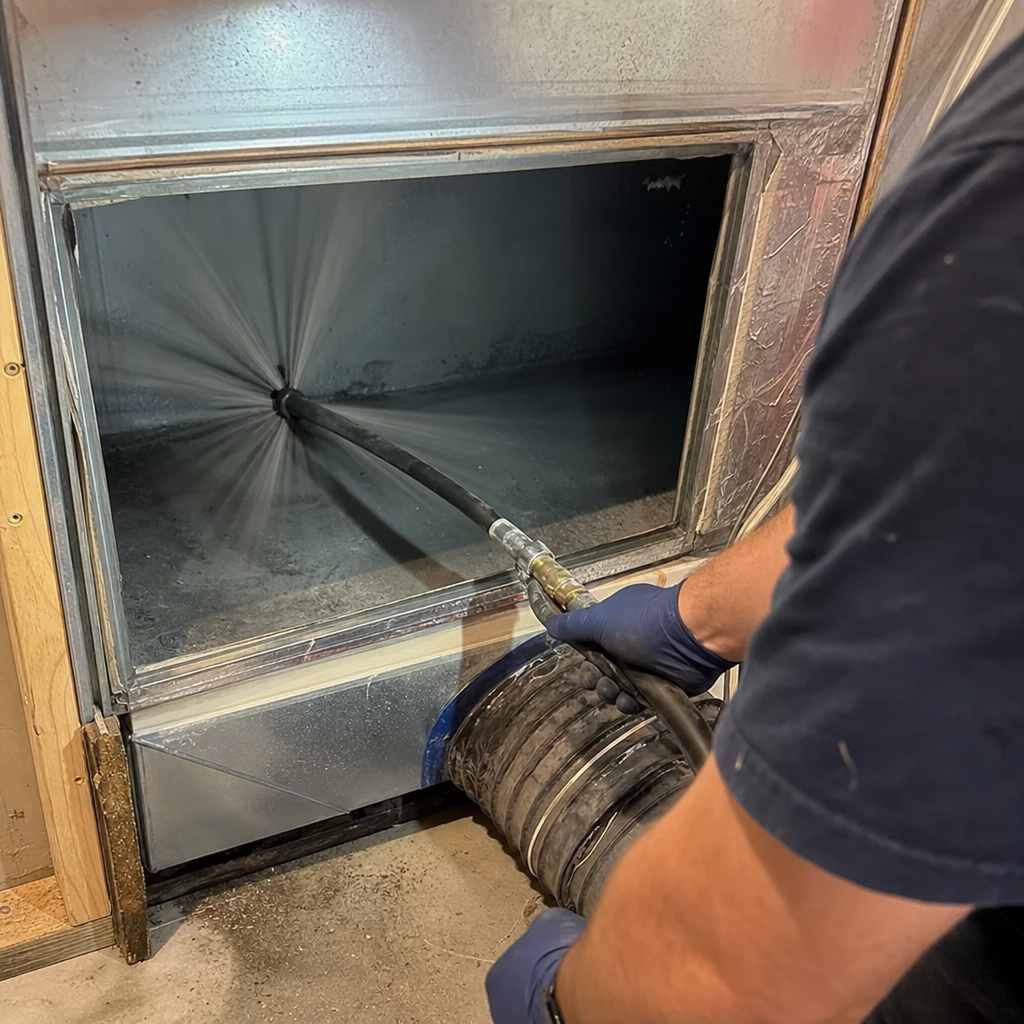
- Agitation and simultaneous extraction: Rotobrush or air whip operates while Nikro negative pressure pulls continuously at the collection point. The debris has one path: out of the duct, through HEPA filtration, into sealed collection.
- Register and boot detail cleaning: Every supply and return boot is individually addressed. This is where push-and-pray fails most obviously — the main trunk looks acceptable, but boots and elbows remain packed.
- Post-cleaning verification: Borescope documentation, pressure differential testing, or visual inspection through access points.
Push-and-pray variations we’ve encountered in Columbus include:
- Compressed-air-only “cleaning”: A technician blows high-pressure air through registers without negative pressure extraction. Debris becomes airborne inside the duct system, then distributes through the home over the following weeks.
- Chemical fogging without source removal: A scented masking agent is aerosolized into dirty ducts. The contamination remains; the odor is temporarily overwhelmed.
- Register-surface wiping presented as “duct cleaning”: The visible register cover is cleaned; the 20 feet of duct behind it is untouched.
The critical distinction: source removal produces debris you can see in the collection chamber. Push-and-pray produces claims without evidence. When Joseph Taylor finishes a Columbus job, the homeowner can inspect the Nikro collection chamber and see exactly what left their system.
Why Columbus’s Older Housing Stock Demands a Different Approach
Approximately 60% of Columbus’s housing inventory was built between 1950 and 1989, and that era produced specific duct configurations that challenge standard cleaning protocols.
Ranch homes with slab foundations (common in Westerville, Dublin, and Grove City): Supply ducts often run through the concrete slab or in soil-contact perimeter chases. These are frequently fiberglass-lined for sound attenuation, and that liner degrades after 30–40 years. We’ve opened slab-duct systems in Columbus where the fiberglass had delaminated and collapsed, creating blockage that looks like contamination but is actually failed duct material. A technician who doesn’t recognize this distinction will “clean” the collapsed liner without addressing the structural failure, and the homeowner gets recurring blockage within months.
Split-levels with partial basements (prevalent in Worthington and Upper Arlington): Return air frequently routes through stud wall cavities and joist panning rather than dedicated ductwork. These cavities collect construction debris for decades — drywall dust, wood chips, insulation fragments — and standard round-duct cleaning tools can’t navigate them. We use rectangular duct attachments and modified agitation methods to address these architectural returns, not just the visible metal trunk.
Flexible duct additions from 1970s–1980s HVAC upgrades: Many Columbus homes have hybrid systems — original galvanized steel trunks with flexible duct branches added during equipment replacement. The flex duct, often sagging or crushed after 40 years, requires different agitation pressure than steel. We’ve seen franchise crews tear flex duct connections with aggressive air pressure, creating leaks that pull attic or crawl space air into the system. Joseph Taylor inspects every flex run before selecting tool pressure and attachment type.
Asbestos-containing duct sealant and tape: Pre-1980 Columbus homes may have asbestos-bearing duct tape or mastic. Disturbing these materials during aggressive cleaning creates serious exposure risk. We identify these materials during pre-cleaning inspection and modify our approach — or recommend abatement referral — rather than proceed blindly.
What a Thorough Job Looks Like: Step by Step
This is the process Joseph Taylor follows on every Columbus job. Timeline for a typical 1,500–2,500 square foot home: 3.5 to 5 hours. Anything significantly shorter indicates corners being cut.
- Pre-cleaning assessment (20–30 minutes): We inspect the furnace, coil, and accessible ductwork. We identify duct material types, access point locations, any asbestos-suspect materials, and equipment condition. In Columbus’s humid climate, we’re specifically checking for microbial growth indicators on fiberglass surfaces and standing water in low-point duct runs.
- System protection and access creation (30–45 minutes): The furnace and coil are sealed with protective barriers. We cut access panels at supply and return trunks using proper sheet metal tools — not hasty cuts that deform duct walls. Every opening is positioned for optimal tool reach and vacuum connection.
- Negative pressure establishment (15 minutes): The Nikro or Abatement Technologies unit connects to the main trunk and pulls continuous negative pressure throughout the system. We verify pressure at distant registers to confirm whole-system engagement, not just trunk-line suction.
- Mechanical agitation and extraction (90–150 minutes): Rotobrush contact cleaning for steel and accessible flex duct; calibrated air tools for rectangular returns and tight elbows. Each register boot is individually addressed. In Columbus’s clay-heavy systems, we often make multiple agitation passes — the first dislodges surface material, the second reaches the adhered layer beneath.
- Component cleaning (30 minutes): Blower wheel, secondary heat exchanger surfaces, and accessible coil sections. These components interact directly with airflow; cleaning ducts without addressing them leaves a contamination reservoir that re-contaminates the system.
- Sanitizing assessment and application (if requested, 20–30 minutes): Where microbial growth is documented or odor concerns exist, we apply EPA-registered sanitizers using Honeywell or Aprilaire application equipment. This is always after source removal, never as a substitute — “clean ducts are only part of the picture” applies here.
- Access sealing and system restoration (30 minutes): Access panels are sealed with mechanical fasteners and mastic, not tape. We test system operation, verify no tools or debris remain, and document collection chamber contents for the homeowner.
How to Verify the Job Was Actually Done
After 11 years, we’ve learned that homeowners who verify get better long-term results — and hold the industry accountable. Here’s what you can check yourself, even without specialized equipment:
- Register boot inspection with a flashlight and phone camera: Remove a supply register and photograph the boot interior before and after. A thorough job shows clean metal or liner; a superficial job shows debris packed at the boot elbow where the vacuum couldn’t reach.
- Filter loading pattern in week one post-cleaning: After legitimate source removal, your filter should load slowly and evenly. If it’s heavily loaded within two weeks, residual debris is still migrating from the system.
- Odor profile during first humid cycle: In Columbus, the first humid period after cleaning tests whether microbial sources were actually removed. Musty odor return indicates incomplete source removal or undiscovered moisture intrusion.
- Request borescope documentation: Any technician with professional equipment (we use Abatement Technologies-compatible borescopes) can provide before/after images from inside the ductwork. Refusal to document is a significant red flag.
- Check the collection chamber: Ask to see what was extracted. A legitimate job with Nikro negative pressure produces visible debris volume. Empty or minimal collection suggests the debris is still in your ducts.
- Verify access panel sealing: All openings created for cleaning should be sealed with permanent methods — sheet metal patches with screws, or proper access doors. Tape-only sealing will fail within 1–2 years, creating leaks that pull unconditioned air and new contamination into the system.
In Columbus’s market, we’ve encountered “cleaning” services that spent 90 minutes on-site and left access holes covered with foil tape that’s already peeling by the time we arrive for the re-clean. Permanent sealing takes longer; it’s also the only method that lasts.
Common Mistakes to Avoid
- Booking based on lowest price in a coupon-heavy market: Columbus sees frequent $89–$149 duct cleaning promotions. These services recover margin through upsell pressure and volume throughput — neither compatible with thorough source removal. The actual cost of professional equipment operation, proper disposal, and 3–5 hours of technician time exceeds these price points before any profit.
- Ignoring the HVAC components: Duct cleaning without blower wheel and coil attention leaves active contamination sources. We’ve cleaned ducts in Columbus homes where the blower wheel alone held enough debris to re-contaminate the system within months.
- Scheduling during peak humidity without moisture control: Cleaning during Columbus’s August humidity, without addressing the moisture source that enabled microbial growth, often produces rapid re-contamination. We sometimes recommend moisture mitigation — dehumidification, duct sealing, or ventilation improvement — before or alongside cleaning.
- Accepting chemical treatments without visible source removal: Sanitizers and sealants have legitimate applications, but only after contamination is physically extracted. “Encapsulation” of visible debris is not cleaning; it’s hiding.
- Neglecting dryer vent cleaning in the same service window: Columbus’s clay particulates and lint combine in dryer vents to create particularly dense blockages. The same fine debris profile affecting your ducts is likely constricting dryer airflow, creating fire risk and efficiency loss. Dryer Vent Cleaning in Akron addresses identical concerns in that market.
- Failing to address duct leakage post-cleaning: Clean ducts with significant leaks pull attic, crawl space, or wall cavity air — reintroducing contamination continuously. HVAC Cleaning in Akron and our Columbus duct repair services include leakage assessment and sealing recommendations.
- Assuming new construction means clean ducts: We’ve extracted construction debris — drywall dust, wood particles, insulation scraps — from Columbus new builds where the HVAC ran during finishing work. “New” does not mean “clean.”
When to Call a Professional
Call for assessment when you notice musty odors at system startup, visible debris at registers, uneven heating or cooling suggesting blockage, or if it’s been more than 5–7 years since professional service. In Columbus’s specific conditions, homes with crawl space or slab ductwork, properties near active construction (clay soil disturbance), and households with allergy-sensitive occupants benefit from more frequent evaluation.
Matrix Air Duct & Vent Cleaning Ohio offers free estimates in Columbus — call (833) 991-6689. Joseph Taylor serves as Lead Technician on every job, so you’ll speak directly with the owner when you call, and the owner will be the one inspecting your system.
Frequently Asked Questions
Professional air duct cleaning in Columbus typically ranges from $300 to $600 for a single-family home, depending on system size, duct material complexity, and contamination level. Homes with slab ductwork, extensive flexible duct, or documented microbial growth fall toward the higher end due to additional time and specialized treatment requirements. Call (833) 991-6689 for an exact quote — estimates are free.
Every 5–7 years for typical residential systems, or sooner if you notice musty odors, visible register debris, or allergy symptom changes. In Columbus specifically, homes near construction zones, properties with crawl space ductwork, or households with pets may need 3–5 year intervals due to accelerated clay particulate accumulation. The humid summers also mean any moisture intrusion should trigger immediate inspection regardless of schedule.
Moderate reductions are possible — typically 5–15% when duct blockage was significantly restricting airflow. The larger energy savings usually come from duct sealing and repair, which we address as a separate service. Clean ducts with major leaks still waste energy; sealed ducts with moderate debris often perform adequately. We assess both conditions during our pre-cleaning inspection.
Safe when properly assessed and modified. Pre-1980 Columbus homes may have asbestos-bearing duct tape or mastic. We identify these materials during inspection and either modify our agitation methods to avoid disturbance or recommend certified abatement referral. We do not proceed with aggressive mechanical cleaning when asbestos-suspect materials are present without proper protocol.
Air duct cleaning addresses the distribution network — supply and return ducts, boots, and registers. HVAC cleaning includes the furnace blower wheel, heat exchanger surfaces, evaporator coil, and cabinet interior. We recommend both together because clean ducts with dirty components re-contaminate quickly, and clean components with blocked ducts can’t distribute conditioned air effectively. Matrix Air Duct & Vent Cleaning Ohio home details our full service scope.
Check register boots with a flashlight for remaining debris, monitor filter loading speed in weeks following service, and request any documentation the previous company provided. Proper jobs produce visible extracted debris, permanent access sealing, and borescope images. If your system was “cleaned” in under two hours with no access panels created, it likely wasn’t source-removal cleaned. We’re frequently called to re-clean after these services in Columbus neighborhoods like Clintonville and Grandview Heights.
The Bottom Line
Air duct cleaning in Columbus isn’t a commodity service — it’s a technical procedure that varies significantly with your home’s age, duct configuration, and the specific contamination profile created by local soil and climate. The difference between a legitimate job and a superficial one shows up in register boots, collection chambers, and odor patterns within weeks. Look for owner-operated accountability, professional-grade equipment with named brands, documented verification methods, and realistic timeframes. In a market flooded with coupon offers and franchise crews, the technician who built the business and stands behind the work personally remains the most reliable indicator of quality.
Ready to see what your ducts actually contain? Air Duct Cleaning in Akron and our Columbus service operate with identical standards — owner on the job, professional equipment, verified results. Call Matrix Air Duct & Vent Cleaning Ohio at (833) 991-6689 for a free estimate. Joseph Taylor will inspect your system personally and show you exactly what a thorough cleaning should accomplish.
For How to Hire a Air Duct Cleaning Contractor in Columbus: A Step-by-Step Guide and Seasonal Air Duct Cleaning Care for Columbus: Year-Round Homeowner’s Guide, see our more guides & resources.
Written by Joseph Taylor, Owner & Lead Technician at Matrix Air Duct & Vent Cleaning Ohio, serving Columbus since 2015.