
Guardsman Air Duct Cleaning in Columbus: A Homeowner’s Guide
Guardsman air duct cleaning in Columbus refers to contractors using industrial-grade negative pressure vacuum systems manufactured by Guardsman — equipment designed for source-removal methodology that captures debris at the point of disturbance rather than pushing it deeper into your HVAC system or back into living spaces. In our 11 years cleaning ducts across Columbus, we’ve found that homeowners who understand what this equipment actually does can spot a legitimate operation from a bait-and-switch crew in about 60 seconds. If you’d rather not become an equipment expert just to hire someone, call (833) 991-6689 — Joseph Taylor handles every Matrix job personally, and we’ll walk you through exactly what’s running in your basement or utility closet.
What Guardsman Equipment Actually Does (Beyond the Name Drop)
Here’s the thing about brand names in this industry: they get thrown around like credentials. We’ve heard competitors mention “professional equipment” on the phone, then show up with a shop vac and a rotary brush from a big-box store. So let’s get specific about what Guardsman vacuum and collection systems are engineered to accomplish.
Guardsman units are built around high-volume negative pressure generation — typically pulling 5,000+ CFM (cubic feet per minute) through HEPA-filtered collection canisters. That suction volume matters because residential ductwork in Columbus homes, particularly the older colonials and split-levels we see in Clintonville and Bexley, has accumulated decades of debris that doesn’t loosen easily. A consumer-grade machine might generate impressive noise without the actual airflow to maintain negative pressure throughout a branched system. The Guardsman design maintains consistent vacuum strength even as hoses extend into distant trunk lines.
The filtration stack is equally critical. These units use multi-stage HEPA containment rated to capture particles down to 0.3 microns at 99.97% efficiency. In practical terms: the dust, pollen, skin cells, and construction debris we’re pulling out of your ducts stays in the canister, not exhausted through a household vacuum’s porous bag into your basement air. We’ve tested this — run a particle counter near inferior equipment during operation, and you’ll watch your indoor air quality temporarily worsen. That’s backwards.
At Matrix Air Duct & Vent Cleaning Ohio home, we pair our source-removal approach with complementary professional-grade equipment from Rotobrush, Nikro, and Abatement Technologies depending on the specific system configuration. The Guardsman vacuum serves as the backbone — the containment engine that makes everything else safe to run.
How Negative Pressure Source-Removal Actually Works
Negative pressure source-removal sounds technical, but the concept is straightforward: we create a controlled vacuum throughout your duct system, then disturb debris at each vent location so the suction pulls it directly into containment. Think of it like a dental suction tool, but scaled to your entire house.
The methodology breaks down into sequential steps:
- System isolation and access creation — We seal returns and supplies, creating a closed loop where the vacuum connects to your main trunk line. This prevents the suction from dissipating into rooms where it’s wasted.
- Negative pressure verification — Before disturbing any debris, we confirm the vacuum maintains consistent negative pressure throughout the system. Weak points indicate leaks that need sealing (one reason we offer Air Duct Cleaning in Akron and surrounding areas with full duct repair capability).
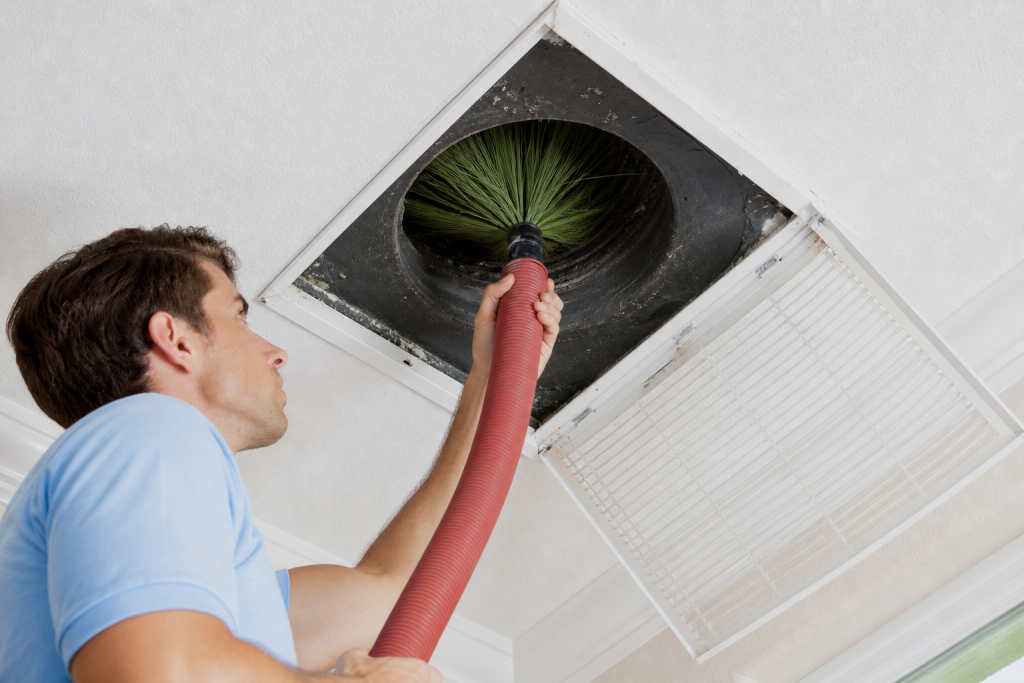
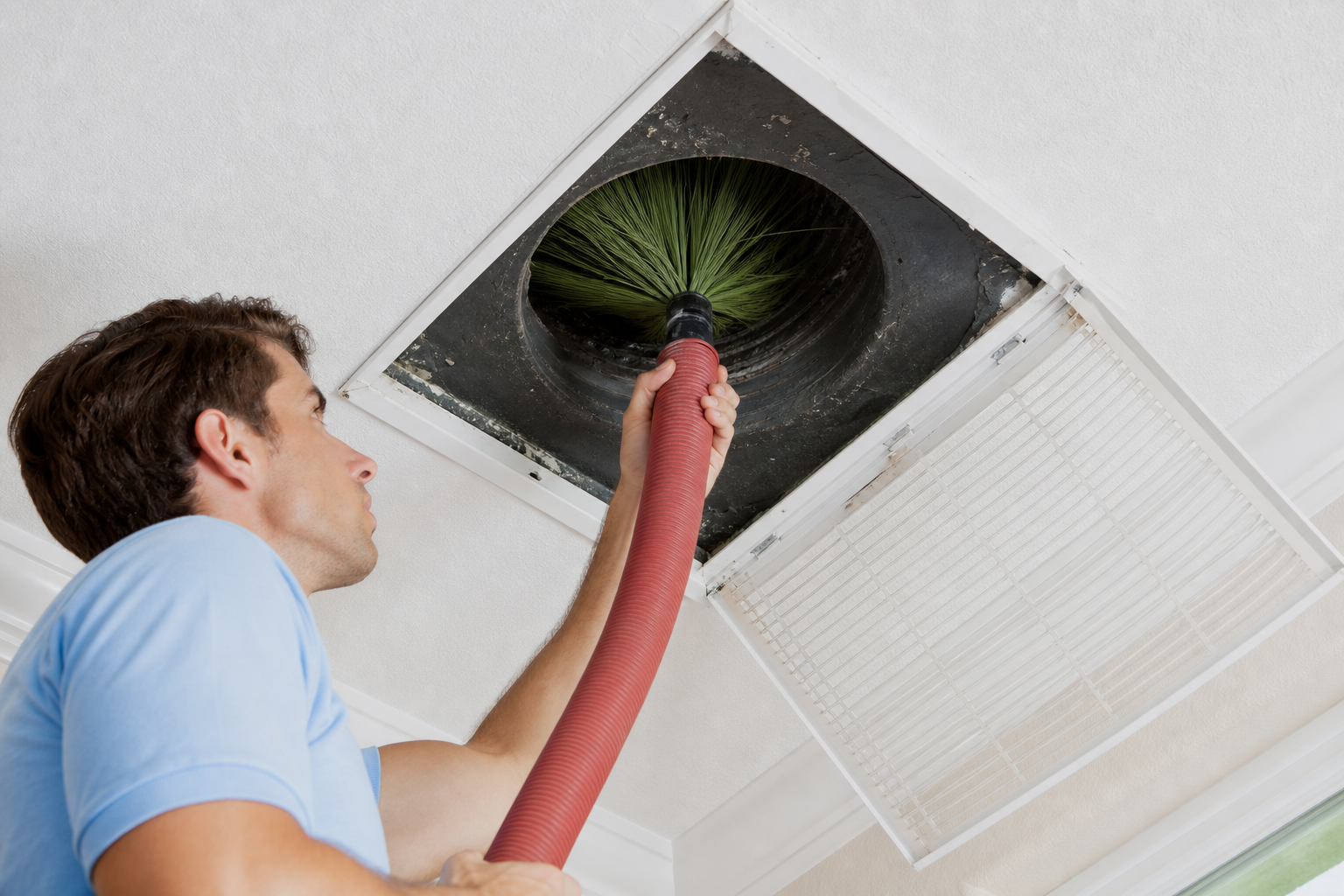
- Mechanical agitation at each vent — Compressed air whips, rotary brushes, or pneumatic tools dislodge buildup. The key: agitation happens while negative pressure is active, so particles enter the airstream and get pulled toward the collection point immediately.
- Trunk line and plenum cleaning — The main distribution channels get direct attention, often through access panels we cut and later seal.
- Post-cleaning verification — Visual inspection through access points, sometimes supplemented with before/after photography we share with homeowners.
Here’s why equipment quality determines success: if your vacuum can’t maintain negative pressure when we open a vent to agitate, you’ve got a brief window where debris becomes airborne with nowhere to go. Consumer-grade machines bog down. Industrial units like Guardsman maintain their pull. In a German Village job last month, we were pulling plaster dust and 1940s-era insulation fragments from a renovated system — the kind of dense, irregular debris that stalls lesser equipment. The homeowner told us a previous “cleaning” had actually left her registers dustier. That’s what happens when agitation outpaces containment.
Why Most Franchise Operations Don’t Carry This Equipment
The economics are revealing. A legitimate Guardsman negative pressure system runs $15,000–$25,000 depending on configuration and HEPA certification level. Add the transport trailer, compressors, and agitation tools, and a properly equipped truck represents serious capital investment.
High-volume franchise models optimize for throughput — multiple jobs daily, standardized 90-minute appointments, technician teams working from scripted protocols. Their equipment needs to fit in a van, deploy fast, and require minimal training. That’s not a criticism of business efficiency; it’s an explanation of why you’ll see portable units that technically “clean” ducts without achieving genuine source-removal.
We’ve been called to redo franchise work in Dublin, Powell, and Westerville where homeowners paid for “complete cleaning” and found the same debris we’d expect in an untouched system. In one case near Polaris, a customer showed us photos of a technician running a 10-foot shop vac hose into a single return vent for 20 minutes, then declaring the job finished. No system isolation. No vent-by-vent agitation. No negative pressure verification. The equipment simply couldn’t support the methodology, so the methodology got skipped.
This is where owner-operated structure matters. Joseph Taylor purchases equipment based on what completes jobs correctly, not what fits a corporate procurement schedule. Over 11 years, that accumulation means we carry the right tool for unusual configurations — the tight crawl spaces in Victorian Village, the commercial-grade systems in converted Short North lofts, the post-remediation cleanups after water damage in flood-prone pockets near the Scioto.
How to Verify Equipment On-Site: A 60-Second Checklist
You don’t need to become a technician to protect yourself. When your contractor arrives, observe four things:
- Physical unit identification — Guardsman vacuums are substantial: typically wheeled canisters or trailer-mounted systems with visible branding and certification plates. If you’re shown a compact unit that one person easily lifts, you’re not looking at industrial negative pressure equipment.
- Sound during operation — High-CFM vacuum motors produce a deep, sustained tone — not the variable whine of an underpowered machine straining against resistance. Listen for consistency; bogs and recoveries suggest the unit can’t maintain pressure against your system’s resistance.
- Technician activity during vacuum run — With proper source-removal, the technician should be actively working individual vents while the vacuum operates continuously. If they start the machine, disappear for 30 minutes, then declare completion, they’re not performing vent-by-vent agitation under negative pressure.
- Containment verification — Ask to see the collection canister before and after. Legitimate operations document debris volume; it’s basic accountability. We photograph ours — homeowners in Columbus deserve to see what came out of their system.
One more tell: the hose diameter. Source-removal requires substantial airflow volume, which means large-diameter vacuum hose (typically 8–10 inches) connecting to your trunk line. Small-diameter flex hose can’t move the air volume needed for whole-system negative pressure, regardless of what the salesperson claimed.
Equipment Quality and Your Family’s Air: The Connection That Matters
The ultimate question isn’t whether your contractor owns impressive machinery — it’s whether your indoor air quality actually improves. Here’s where equipment tier creates measurable difference.
Incomplete source-removal disturbs debris without containing it. We’ve measured this: particle counts spike during and after substandard cleanings because agitation liberates material that then recirculates before settling. A proper Guardsman-class system with verified HEPA filtration captures that material at the collection point. Post-cleaning particle counts in Columbus homes we’ve serviced typically drop 40–60% from baseline, measured at supply registers 24 hours after completion.
The equipment also enables services beyond basic cleaning. When we perform HVAC Cleaning in Akron and Columbus properties, the same negative pressure infrastructure supports safe handling of microbial contamination — we can apply EPA-registered sanitizers from Honeywell and Aprilaire product lines, then extract residual moisture and treatment byproducts without reintroducing them to your air. Clean ducts are only part of the picture; the equipment determines whether your “cleaning” improves conditions or merely rearranges them.
For properties with persistent odor issues or post-construction contamination, this capability matters. We handled a renovation cleanup in Upper Arlington where contractors had cut drywall and hardwood without isolating returns — fine particulate throughout the system. Consumer-grade equipment would have pushed that silica-laden dust through living spaces for weeks. Industrial negative pressure with proper filtration removed it in one controlled session.
When to Call a Pro in Columbus
Some situations justify immediate professional assessment rather than continued monitoring:
- Visible debris expelling from supply registers when your HVAC cycles on
- Persistent musty or chemical odors that intensify when the system runs
- Recent renovation or rodent activity with suspected duct contamination
- Family members with unexplained respiratory symptoms that improve when away from home
- Previous “cleaning” that didn’t include vent-by-vent work or equipment verification
In our experience across Columbus — from the aging infrastructure of Franklinton to the tight new construction in New Albany — these symptoms rarely resolve without intervention, and DIY attempts with household equipment typically make distribution worse.
Related services in Columbus: For comprehensive system care, we also offer Dryer Vent Cleaning in Akron and surrounding Columbus metro areas — lint accumulation creates genuine fire risk, and the same attention to proper equipment applies.
The Bottom Line
Guardsman air duct cleaning in Columbus isn’t a magic phrase — it’s a specific equipment category that enables a specific methodology. Homeowners who understand this distinction protect themselves from the $99 coupon operations that dominate search results and mailbox flyers. The legitimate question isn’t “do you use good equipment?” but “show me how your vacuum maintains negative pressure, and explain what happens to debris after agitation.”
At Matrix Air Duct & Vent Cleaning Ohio, Joseph Taylor brings 11 years of specialized duct and indoor air quality experience to every job, backed by professional-grade equipment from Guardsman, Rotobrush, Nikro, and Abatement Technologies. Our 227 verified reviews reflect what happens when the owner is on the job with the right tools — not a rotating subcontractor working from a checklist.
If you’re evaluating duct cleaning options in Columbus and want straight answers about methodology, equipment, and what to expect, call (833) 991-6689. We offer free estimates, and we’ll show you exactly what’s running in your system before we start.
Frequently Asked Questions
Legitimate source-removal duct cleaning in Columbus typically runs $400–$800 for a standard residential system, with larger homes or complex configurations extending toward $1,200. The $99–$149 offers you see advertised generally exclude trunk line work, use portable equipment incapable of negative pressure methodology, or involve upsell pressure once technicians arrive. Call (833) 991-6689 for an exact quote based on your square footage and vent count — estimates are free.
You can remove surface debris from individual register covers, but shop vacuums lack the airflow volume and sealed containment to perform source-removal throughout a duct system. More critically, without negative pressure isolation, agitation in one vent pushes debris into adjacent branches and living spaces. For homes with significant accumulation or post-construction contamination, professional equipment prevents the redistribution problem that makes DIY attempts counterproductive.
Every 3–5 years for typical residential occupancy, sooner if you have pets that shed heavily, recent renovation activity, or family members with allergies or respiratory conditions. Columbus’s seasonal pollen cycles — particularly the dense tree pollen of April and May — accelerate accumulation in systems that draw significant outdoor air. Homes near construction zones or with older, leakier ductwork may need more frequent attention.
Cleaning removes physical debris through mechanical agitation and vacuum extraction. Sanitizing applies EPA-registered antimicrobial treatments to address microbial growth — mold, bacteria, or biofilm — that cleaning alone doesn’t eliminate. We recommend cleaning first, then assessing whether visible microbial activity or persistent odor justifies sanitizing with Honeywell or Aprilaire treatment protocols. Not every home needs both, and we’re upfront about when sanitizing adds genuine value versus when it’s an unnecessary upsell.
Written by Joseph Taylor, Owner & Lead Technician at Matrix Air Duct & Vent Cleaning Ohio, serving Columbus since 2015.
Need Air Duct Cleaning Help?
Call Matrix Air Duct & Vent Cleaning Ohio — licensed & insured, here with fast after-hours help in Ohio.
(833) 991-6689