
Last updated September 3, 2026
Seasonal Air Duct Cleaning Care for Columbus: Year-Round Homeowner’s Guide
Spring pollen counts in Columbus rank among the highest in Ohio — and most of that yellow dust gets pulled through your return air system within the first two weeks of bloom. That means late April is actually the worst possible time to discover your ducts are packed with last year’s debris. After 11 years cleaning duct systems across Columbus, from Victorian Village to New Albany, we’ve learned that treating duct maintenance as a once-a-year checkbox ignores how dramatically our four seasons change what’s circulating through your home. This guide maps what actually accumulates in Columbus ductwork by season — pollen, humidity, leaf mold, combustion byproducts — and builds a smarter maintenance rhythm around those real patterns instead of arbitrary calendar dates.
Quick Answer
The best seasonal duct care plan for Columbus homeowners pairs early fall deep cleaning, and you can find more guides & resources online (after summer humidity, before furnace season) with targeted spring inspections and filter upgrades timed to pollen peaks. Most Columbus homes benefit from full professional cleaning every 18–24 months, with filter changes accelerated to every 6–8 weeks during high-load seasons.
Table of Contents
- Spring: Pollen Invasion and the Return Air Problem
- Summer: Humidity, Mold Spores, and Condensation Risks
- Fall: The Optimal Cleaning Window for Columbus Homes
- Winter: Combustion Byproducts and Freeze-Thaw Duct Stress
- Using Shoulder Seasons for Smart, Low-Cost Maintenance
- Seasonal Filter Schedules That Protect Your Ducts
- Common Mistakes to Avoid
- When to Call a Professional
- Frequently Asked Questions
Spring: Pollen Invasion and the Return Air Problem
Columbus sits in a pollen corridor. The city’s mix of oak, maple, birch, and grass species produces some of the highest spring pollen counts in Ohio — typically peaking between late April and mid-May when counts regularly exceed 1,500 grains per cubic meter. Here’s what most homeowners miss: your return air grille doesn’t discriminate. It pulls in everything — pollen that slipped through windows, tracked-in grass clippings, pet dander that winter concentrated indoors.
In our experience, the first two weeks of heavy pollen season are when Columbus return ducts get slammed. We see it every year in homes near Schermeier Research Wetlands and the Olentangy River corridor, where tree density is highest; our Air Duct Cleaning Maintenance Checklist for Columbus Homeowners can help you track these risks. The pollen doesn’t just sit in your filter. Fine particles bypass standard filters and adhere to duct walls, especially in the flexible ductwork common in 1990s–2000s Columbus subdivisions.
What to do in spring:
- Upgrade your filter two weeks before the pollen forecast spikes. In Columbus, that’s typically mid-April. Move from MERV 8 to MERV 11 if your system can handle the static pressure — check your HVAC manual or call your technician.
- Inspect your return grille and first few feet of duct. Remove the grille and look for yellow-green buildup. If you see it there, the rest of the run likely has coating too.
- Schedule a targeted return-side cleaning if you skipped fall maintenance. This is a lighter, lower-cost service than full-system cleaning — we often recommend it for Columbus homeowners who are between full-service cycles.
- Run your fan continuously during peak pollen days. This keeps air moving through the filter rather than letting pollen settle in ductwork. Yes, it costs more in electricity — but it’s cheaper than accelerated duct contamination.
The key insight: spring isn’t the time for full duct cleaning in Columbus. The pollen is still coming. You’re fighting the current. Save deep cleaning for when the assault ends.
Summer: Humidity, Mold Spores, and Condensation Risks
Columbus summer humidity averages 70–75% in July and August, with dew points that regularly hit the uncomfortable mid-60s. Your ductwork becomes a condensation machine under these conditions — especially if you have any duct runs passing through unconditioned attic spaces, which is standard in many Clintonville and Bexley homes built before 1980.
Here’s the mechanism: cold supply air hits warm, humid attic air at duct joints and insulation gaps. Condensation forms. That moisture feeds mold spores that entered through your outdoor air intake or simply existed dormant in dust accumulations. By late August, we’ve opened duct systems in Columbus homes that smell musty the moment the access panel comes off — even when homeowners never noticed a problem.
Summer-specific risks we see in Columbus:
- Attic duct sweating: Most common in homes with R-4 or R-6 duct insulation — below current code. The condensation doesn’t just mold; it degrades duct tape and mastic seals.
- Basement humidity infiltration: Columbus’s clay-heavy soils mean basements stay damp. Return ducts in unfinished basements pull that moisture directly into the system.
- Short-cycling compressors: When ducts leak cool air into attics, your AC runs longer, creating more condensation cycles. It’s a feedback loop.
Summer maintenance isn’t about cleaning — it’s about inspection and moisture control. Check your attic ducts for sweating. Look for water stains on ceiling drywall below duct runs. If you smell mustiness when the AC first kicks on, that’s mold in the system, not just “old house smell.”
For Columbus homeowners with persistent humidity issues, we often pair duct inspection with whole-home dehumidification solutions using Aprilaire or Honeywell equipment — treating the root cause rather than cleaning up symptoms repeatedly.
Fall: The Optimal Cleaning Window for Columbus Homes
Early fall — mid-September through mid-October — is the single best window for full duct cleaning in Columbus. Here’s why this timing matters so much:
The summer humidity has dropped. Mold spores that might have been active are now dormant and dry — ideal conditions for mechanical removal with a Rotobrush or Nikro system. The pollen season is finished. Leaf mold hasn’t peaked yet (that comes with late October rains and the first heavy leaf drop). And critically: your furnace hasn’t started working hard yet.
Starting heating season with clean ducts matters more than most Columbus homeowners realize. Furnaces move air more slowly than air conditioners, which means any particulate in the system gets heated and recirculated rather than flushed. Combustion byproducts from a furnace — even a properly functioning one — add to whatever’s already in your ducts. Starting from a clean baseline means you’re not baking last year’s dust and summer’s mold into your winter air.
The fall cleaning checklist we use on Columbus jobs:
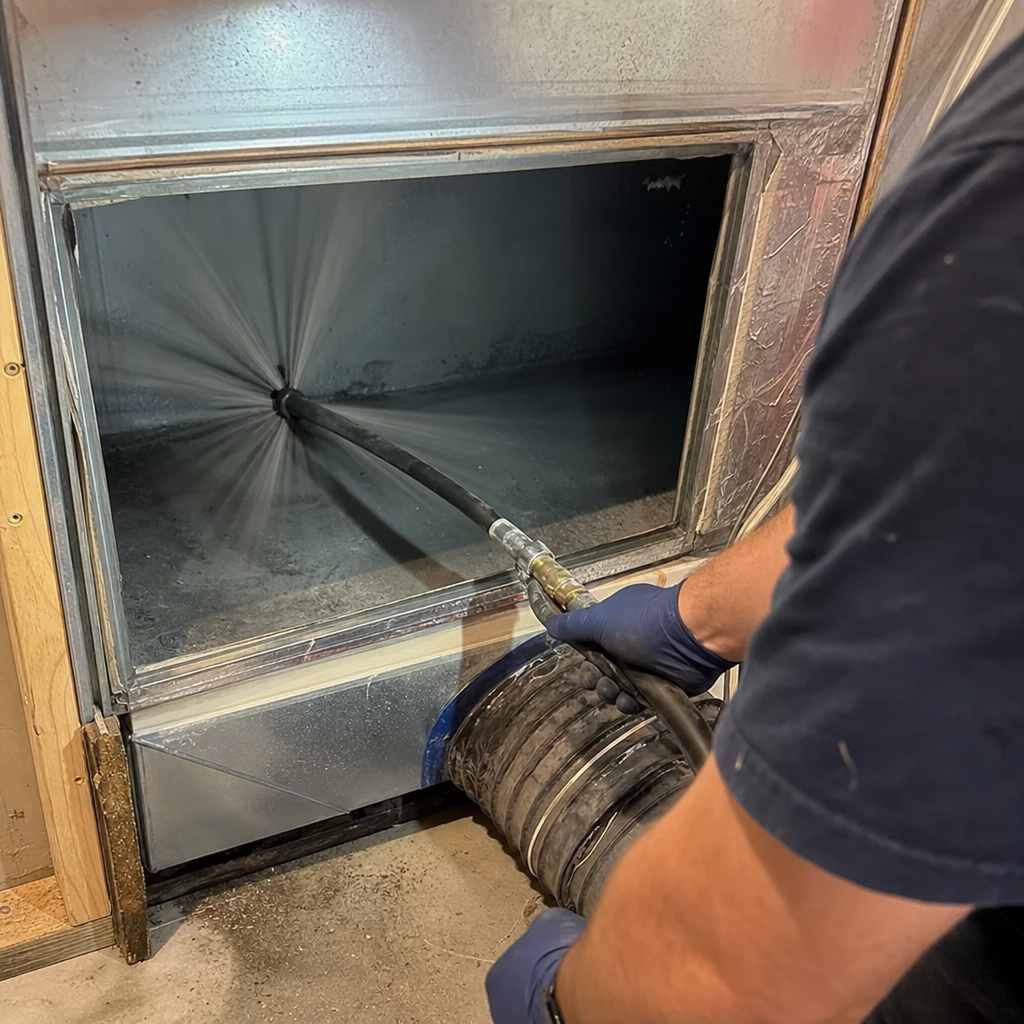
- Full supply and return cleaning with brush-and-vacuum systems — we run Rotobrush equipment on residential jobs for mechanical agitation that dislodges adhered debris without damaging flex duct.
- Register and grille deep cleaning — these collect the most visible debris and are often skipped by low-bid services.
- Condensate pan and drain inspection — summer’s humidity leaves residue that can clog drains or harbor bacteria.
- Duct integrity check — looking for separations, crushed flex runs, and insulation damage from summer heat.
- Filter housing cleaning — the area around your filter collects bypass debris that standard filter changes miss.
We schedule our heaviest Columbus workload in this window. Homeowners who book September appointments get the best technician availability and avoid the November rush when everyone realizes their furnace smells funny on first startup.
Winter: Combustion Byproducts and Freeze-Thaw Duct Stress
Columbus winters average 22–28°F with frequent freeze-thaw cycles — temperatures swing above and below freezing 40–50 times per season. That thermal movement stresses ductwork in ways that summer stability doesn’t.
Metal duct expands and contracts. Mastic seals crack. Flex duct pulls at connections. In homes with crawl space or attic duct runs — common in German Village renovations and post-war ranch construction — we’ve found separated joints every spring that were tight the previous fall. The freeze-thaw cycle is the culprit.
More concerning: winter is when combustion byproducts matter most. Gas furnaces produce carbon monoxide, nitrogen dioxide, and water vapor as normal exhaust. A properly vented system handles these. But if your heat exchanger has a crack, or your flue has backdrafting issues, those byproducts can enter the supply air stream; learn more about Air Duct Cleaning Permits, Codes & Inspections in OH: What You Need to Know. Clean ducts won’t fix a cracked heat exchanger — but dirty ducts can mask the warning signs. Homeowners assume the smell or irritation is “dust burning off,” when it’s actually a combustion problem.
Winter duct care for Columbus:
- Change your filter monthly. Heating season filters load faster because air moves slower and static pressure drops across the filter increase.
- Listen for new rattles or whistles. These often indicate duct separations from thermal cycling.
- Watch for uneven heating between rooms. A duct that separated in an unconditioned space will deliver less air, creating cold spots.
- Schedule a furnace safety inspection separately from duct cleaning. These are different services. We don’t do combustion analysis — we partner with HVAC contractors who do, and we coordinate timing when duct repair is needed.
The freeze-thaw issue is particularly relevant for Columbus’s older housing stock. Homes in Victorian Village, Italian Village, and the Near East Side often have duct systems modified multiple times over decades. Each modification is a potential failure point under thermal stress.
Using Shoulder Seasons for Smart, Low-Cost Maintenance
Not every duct service needs to be a full-system cleaning. Columbus’s spring and fall shoulder seasons are ideal for targeted, lower-cost interventions that extend the interval between deep cleanings.
Spring shoulder (late March to mid-April):
Before pollen hits, we offer what we call a “pre-season intake service” — focused cleaning of return grilles, the first 3–4 feet of return duct, and filter housing prep. This removes the accumulated winter debris that would otherwise become a pollen adhesive surface. Cost runs roughly 40–50% of full cleaning. For Columbus homeowners who had fall service, this often means going 18–24 months between full cleanings instead of annual.
Fall shoulder (late October to early November):
After the main cleaning window closes, we do “winterization inspections” — checking duct integrity, sealing accessible joints with mastic, and verifying insulation integrity before hard winter. This is especially valuable for homes with attic or crawl space duct runs in Columbus’s 5a/5b hardiness zone, where winter temperatures regularly drop below 0°F.
The economics work out: two shoulder-season targeted services over three years typically cost less than annual full cleanings, with better results because you’re addressing seasonal-specific problems at the right time.
Seasonal Filter Schedules That Protect Your Ducts
Your filter is your duct system’s first defense — but running the wrong filter on the wrong schedule can be worse than no filter at all. Here’s what we recommend for Columbus homes based on 11 years of seeing what actually works.
| Season | MERV Rating | Change Interval | Columbus-Specific Note |
|---|---|---|---|
| Spring (Apr–May) | MERV 11–13 | Every 4–6 weeks | Pollen peaks demand maximum filtration; watch static pressure |
| Summer (Jun–Aug) | MERV 8–11 | Every 8–10 weeks | Humidity can cause high-MERV filters to load faster with moisture |
| Fall (Sep–Oct) | MERV 11 | Every 6–8 weeks | Leaf mold and harvest dust peak; good time to upgrade before heating |
| Winter (Nov–Mar) | MERV 8–11 | Every 4–6 weeks | Heating season static pressure runs higher; check monthly |
Critical filter facts most Columbus homeowners miss:
- Higher MERV isn’t always better. A MERV 13 filter in an older Columbus home with a 1-ton undersized blower can actually reduce airflow enough to freeze AC coils in summer or trip high-limit switches in winter.
- The “30-day” fiberglass filter is a trap. It lets so much through that your ducts contaminate faster. Spend the extra $3–4 on pleated.
- Filter direction matters. The arrow points toward the blower — we’ve found backwards filters in probably 15% of Columbus homes we service.
If you’re unsure what your system can handle, check the blower door or call your HVAC technician. We note filter recommendations on every service report we leave with Columbus customers.
Common Mistakes to Avoid
- Cleaning ducts in late April. You’re paying to remove debris that will be replaced by pollen within two weeks. Wait until early June or do a targeted return cleaning instead.
- Ignoring the dryer vent. Columbus’s humid summers make lint buildup more problematic, and winter static increases fire risk. Dryer vent cleaning should run on its own seasonal cycle — typically fall, when lint is dryest and easiest to remove completely.
- Using “sealant” sprays instead of mechanical cleaning. Some Columbus-area services pitch antimicrobial coatings applied without cleaning. You’re sealing debris in place. We don’t offer this — proper HVAC cleaning removes source material first.
- Assuming new construction means clean ducts. Columbus’s building boom in New Albany, Powell, and Delaware County has produced homes with construction debris in ducts for years. Drywall dust, in particular, is so fine it bypasses filters and coats duct walls.
- Setting the thermostat to “fan on” continuously without filter upgrades. This circulates more air through the filter, which is good — but it loads the filter faster, which is bad if you don’t accelerate your change schedule.
- Waiting for visible dust at registers. By the time you see it, your supply ducts are heavily loaded. The first sign is usually allergy symptoms or a musty smell — both mean you’re already behind.
- Treating duct cleaning as a commodity purchase. The $49 coupon services in Columbus typically run a vacuum hose from the register for 20 minutes and leave. We’ve been called to clean up after them — the ducts weren’t clean, and sometimes equipment was damaged.
When to Call a Professional
Some duct conditions in Columbus homes require professional assessment beyond what DIY inspection can provide. Call for service if you notice persistent musty odors when the system runs, visible mold at registers or in the plenum, uneven heating or cooling between rooms that worsened after winter, or rodent or insect evidence in ductwork.
After 11 years specializing in air duct and indoor air quality services, we’ve developed a straightforward approach: the owner is on the job. Joseph Taylor personally serves as Lead Technician on every Matrix service call — you’re not getting a rotating crew of subcontractors dispatched from a call center. We carry professional-grade equipment from Rotobrush, Nikro, and Abatement Technologies — the same brands used by commercial IAQ contractors — and our scope extends beyond cleaning to duct repair and sealing and air quality sanitizing when root causes need addressing.
Matrix Air Duct & Vent Cleaning Ohio offers free estimates in Columbus — call (833) 991-6689. We’ll inspect your system, explain what we find, and recommend only what’s actually needed for your home’s specific seasonal challenges.
Frequently Asked Questions
Full residential duct cleaning in Columbus typically ranges from $350 to $650 for a standard single-system home, with larger homes or multiple zones running higher. Factors that affect pricing include system accessibility, contamination level, and whether duct repair or sealing is needed. Call (833) 991-6689 for a free exact quote — we price by the job, not by the vent, so there are no surprises.
Most Columbus homes benefit from full professional cleaning every 18–24 months, with targeted return-side or register services in between. Homes with pets, allergy sufferers, or recent renovation may need annual full service. The seasonal pattern matters more than the calendar — early fall cleaning before heating season is optimal for our climate.
Yes — significantly. Pollen that enters your Columbus home gets pulled into return ducts, where it mixes with existing dust and pet dander. When the system runs, that concentrated allergen load redistributes through supply vents. Clean ducts mean pollen has less to adhere to and gets filtered out faster.
Duct cleaning addresses the distribution network — the metal or flex runs that carry air to rooms. HVAC cleaning includes the blower, evaporator coil, and plenum — the components that condition air before distribution. For Columbus homes with persistent air quality issues, we often recommend both. See what 227 customers say about our combined service approach.
For full-system cleaning, yes — early fall is superior. Summer humidity has dropped (better for mold remediation), pollen season has ended, and your furnace hasn’t started working hard yet. Starting heating season with clean ducts means you’re not recirculating baked-in debris all winter. Spring is better for targeted return-side maintenance only.
Listen for new rattling or whistling when the blower runs, feel for uneven airflow at registers, and watch your energy bills for unexplained increases. In Columbus’s older neighborhoods — German Village, Victorian Village, the Near East Side — we find separated duct joints every spring that were intact the previous fall. A professional inspection with a borescope camera can confirm integrity without cutting into walls.
The Bottom Line
Columbus’s four distinct seasons each present different duct contamination challenges: spring pollen overload, summer humidity and mold risk, fall’s optimal cleaning window, and winter’s combustion byproducts plus freeze-thaw mechanical stress. The smartest homeowners don’t clean on autopilot — they match service type and timing to what’s actually entering their system. Early fall full cleaning, spring targeted return maintenance, and seasonally adjusted filter schedules will keep your air cleaner and your costs lower than annual one-size-fits-all service. Clean ducts are only part of the picture — when inspection reveals leaks, damage, or persistent contamination sources, repair and sealing address root causes rather than treating symptoms repeatedly.
Ready to schedule your fall duct cleaning or get a free assessment of your Columbus home’s seasonal needs? Call Matrix Air Duct & Vent Cleaning Ohio at (833) 991-6689. Joseph Taylor personally handles every service call, and we’ll give you a straightforward recommendation — no upsells, no scare tactics, just 11 years of focused expertise applied to your specific system.
Written by Joseph Taylor, Owner & Lead Technician at Matrix Air Duct & Vent Cleaning Ohio, serving Columbus since 2015.