
Fast, Reliable Duct Repair & Sealing Across Fort Wright
Duct repair and sealing in Fort Wright typically costs $280–$750 depending on whether you’re sealing accessible joints or rebuilding sections of original 1960s ductwork, and most jobs are completed in a single visit. If your Fort Wright home still has its original sheet-metal trunk lines or open stud-bay returns from the post-war building boom, you’re losing conditioned air every time your HVAC cycles—often 25–40% before it ever reaches your vents. We’re Joseph Taylor and the team at Matrix Air Duct & Vent Cleaning Ohio, and our Duct Repair & Sealing crew works Fort Wright’s hillside neighborhoods regularly. From Forest Park to the streets off Kyles Lane, we know the 1950s–1970s housing stock that defines this Kenton County suburb, and we carry the professional-grade equipment to fix what generic duct cleaners won’t touch. Call (833) 991-6689 for a free estimate—most Fort Wright homeowners get same-week scheduling.
Why Matrix Air Duct & Vent Cleaning Ohio Is Fort Wright’s Preferred Duct Repair & Sealing Company
We’ve built our reputation one job at a time over 11 years, and Fort Wright homeowners have noticed. Our 227 verified reviews average 4.8 stars, with repeat calls from Northern Kentucky customers who’ve learned that the owner himself shows up to handle the work. Joseph Taylor doesn’t dispatch subcontractors from a corporate hub—he’s the lead technician on every duct repair and sealing job we run.
That matters in Fort Wright especially. These hillside streets with their slab-on-grade ranches and split-levels built into the slope require someone who recognizes what he’s looking at when he opens a crawl-space hatch and finds original crimped-duct trunks dumping heat into the dirt. We’ve worked enough Fort Wright basements to spot the telltale signs: rust streaks on sheet metal from decades of Ohio River valley condensation, fiberglass debris packed into open stud bays, fiberboard panels swollen from humidity re-emulsifying old mastic.
Our response time to Fort Wright averages same-day to next-day during peak season, and we carry Rotobrush and Abatement Technologies equipment on every truck—no waiting for a second crew to bring specialized tools. When you’re breathing air that’s been passing through unsealed wall cavities for 50 years, you don’t want a rotating cast of strangers guessing at the problem. You want the same experienced technician who diagnosed the last job and will stand behind this one.
Our Duct Repair & Sealing Services in Fort Wright
Duct Sealing
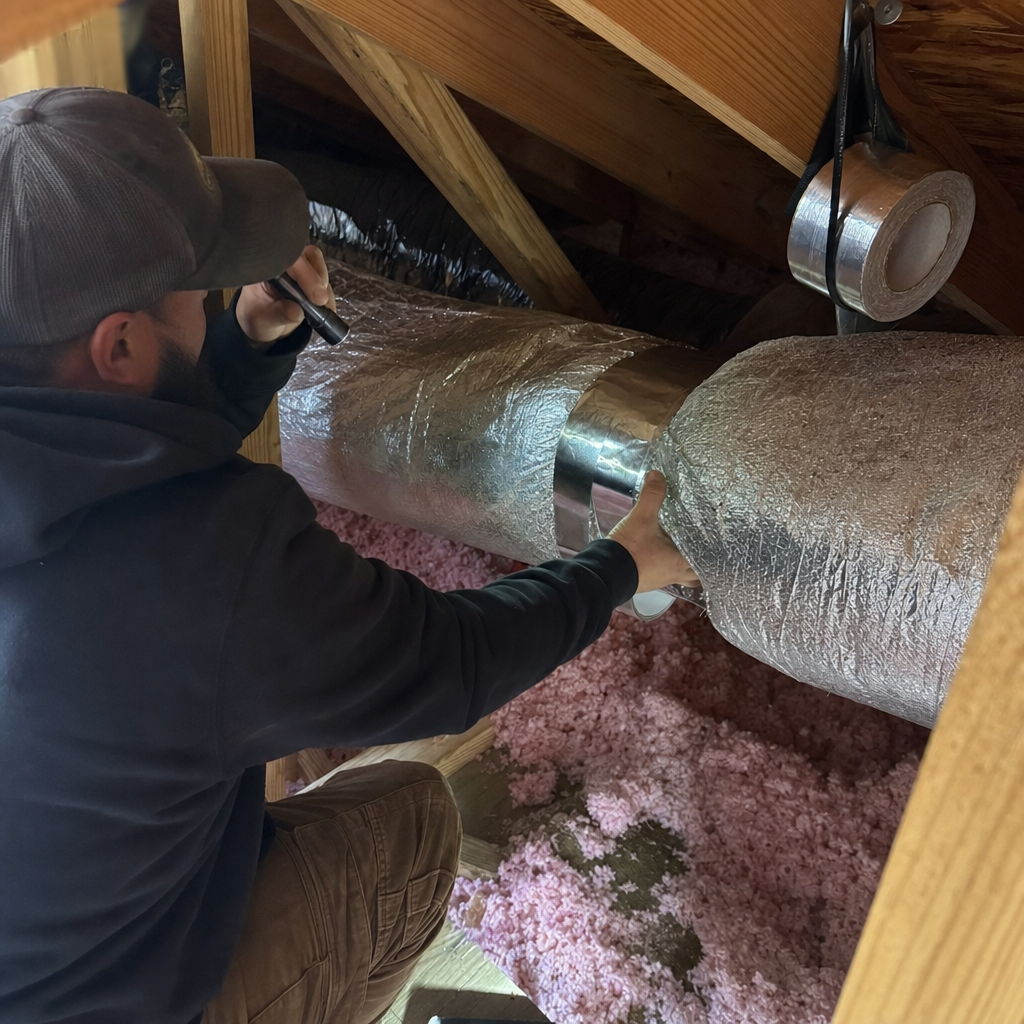
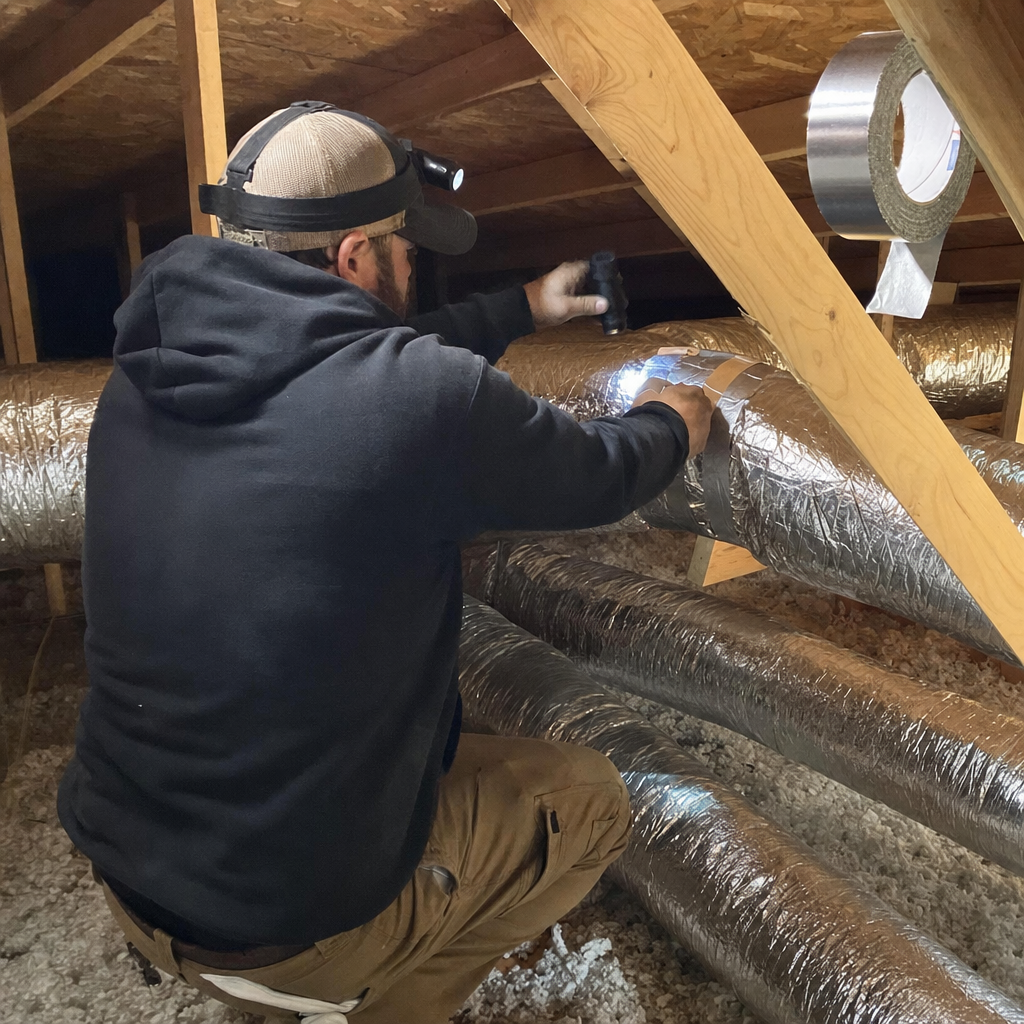
Most Fort Wright homes lose 25–35% of conditioned air through leaks before it reaches the registers. We seal supply and return ductwork using mastic sealant and metal-backed tape rated for HVAC applications—not the failing duct tape you’ll find on decades-old joints. In Fort Wright’s 1960s–70s split-levels, we regularly find crimped sheet-metal connections that have separated from foundation settling on hillside lots; we disassemble, reseat, and seal each joint properly. On a recent job near Forest Park, we cut air loss from 38% to 6% using a combination of mastic sealing and targeted joint rebuilding.
Flex Duct Repair
Some Fort Wright homes have had partial retrofits with flex duct in attic or crawl-space runs, often installed poorly by previous owners. Flex duct that’s kinked, crushed, or disconnected at the collar wastes energy and circulates unconditioned crawl-space air. We replace damaged flex sections with properly sized, insulated runs and secure them with mechanical fasteners—not zip ties that degrade in Fort Wright’s humid crawl spaces. If your flex duct is running through an unconditioned space on a hillside lot, proper insulation and sealing is critical; the temperature differential between your 55°F crawl space and 70°F supply air creates condensation that destroys standard duct board.
Metal Duct Repair
The original galvanized steel trunks in Fort Wright’s post-war ranches are built to last, but they’re rarely built to seal. Crimped joints, snap-lock seams, and poorly fitted takeoffs leak constantly. We repair separated seams, replace rusted sections, and rebuild damaged takeoffs using proper sheet-metal fabrication techniques. Where original trunks have been modified by handymen over the decades—extra holes drilled, mismatched fittings cobbled together—we restore proper airflow geometry. These systems can perform for another generation if sealed correctly; replacement is rarely necessary.
Duct Insulation
Fort Wright’s Ohio River valley location means summer dewpoints in the low-to-mid 70s°F, and supply ducts running through unconditioned crawl spaces sweat badly. Wet insulation loses R-value, drips onto floor joists, and creates mold conditions. We replace degraded insulation with properly sealed vapor-barrier wraps, paying special attention to trunk lines on north-facing hillside foundations where condensation is worst. Proper insulation after sealing prevents the re-emulsification of mastic that we see repeatedly on Fort Wright’s older fiberboard panels.
Mastic Sealant Application
For Fort Wright’s legacy duct systems, mastic is the only proper sealant. We brush-apply water-based mastic to every seam, joint, and penetration, building a flexible, permanent seal that outlasts tape by decades. This is especially critical on the original sheet-metal trunks we find in Fort Wright’s 1950s–1970s homes, where thermal expansion and contraction from four-season Kentucky weather has opened hairline gaps that compound over years. Mastic remains our standard on every sealing job—we don’t shortcut with tape alone.
Air Leak Repair
Beyond duct leaks, we repair the pressure boundary failures that make duct leaks worse: disconnected return plenums, filter rack gaps, and cabinet seams in the air handler itself. In Fort Wright homes with open stud-bay returns, these boundary leaks are often the primary problem; sealing the duct does little if the return path is an unsealed wall cavity pulling attic or crawl-space air. We identify and address these systemic issues rather than chasing individual leaks.
What happens when you call
- 1
A real person answersNo phone trees — you reach a local pro.
- 2
You get an upfront price rangeHonest numbers before anyone is dispatched.
- 3
A background-checked tech heads outLicensed & insured, dispatched right away.
- 4
You approve before work beginsNothing starts until you say go.
Trusted Brands We Service in Fort Wright
We carry professional-grade equipment and materials from the brands commercial IAQ contractors trust: Rotobrush for mechanical agitation and debris removal, Abatement Technologies for HEPA containment and air scrubbing, and Aprilaire for humidity control and filtration integration. For sealing and repair, we stock Guardsman-rated mastic compounds and metal-backed tapes sized for the sheet-metal gauges common in Fort Wright’s older systems. We don’t order parts from a warehouse three counties away—we keep common fittings, insulation wraps, and sealants on the truck so Fort Wright jobs aren’t delayed waiting for a delivery. When your crawl space is 95°F and humid, you want the repair finished today, not next Tuesday.
Common Duct Repair & Sealing Problems We See in Fort Wright Homes
- Open stud-bay returns acting as debris traps. Fort Wright’s 1960s–70s homes frequently used open wall cavities lined with drywall as return-air paths instead of sealed metal ductwork. Decades of fiberglass insulation particles, drywall dust, rodent droppings, and construction debris accumulate in these cavities and circulate directly into living spaces—there’s no duct to clean or seal until we retrofit proper return ducting.
- Original sheet-metal trunks with failed crimped joints. The supply trunks in Fort Wright’s post-war ranches were assembled with crimp-and-snap joints that weren’t designed to flex. Foundation settling on hillside lots gradually separates these connections, dumping conditioned air into crawl spaces and pulling humid, unconditioned air back into the system.
- Mastic re-emulsification on fiberboard duct panels. Fort Wright’s high summer humidity causes water-based sealants to break down on fiberboard ductwork common in 1970s builds. The panels themselves swell and delaminate, creating leaks that didn’t exist when the system was originally sealed. We remove degraded fiberboard and replace with sealed metal where possible.
- Condensation damage in unconditioned crawl spaces. Ductwork routed through Fort Wright’s hillside crawl spaces experiences extreme temperature differentials—cold supply air in humid summer conditions creates sustained condensation that rusts metal, degrades insulation, and promotes mold. Proper sealing must be paired with adequate insulation and vapor barrier to prevent recurrence.
Pricing for Duct Repair & Sealing in Fort Wright, KY
Here’s what Fort Wright homeowners typically invest to fix their legacy duct systems:
| Service | Typical Range in Fort Wright |
|---|---|
| Basic duct sealing (accessible joints, mastic application) | $280–$450 |
| Flex duct repair/replacement (per run) | $180–$340 |
| Metal duct section repair or rebuild | $320–$580 |
| Open stud-bay return retrofit with sealed ducting | $650–$1,200 |
| Duct insulation replacement (per trunk line) | $220–$400 |
| Full system assessment with flow-hood testing | $150–$250 (credited toward work) |
Fort Wright’s older housing stock often requires more labor than newer suburbs because we’re working in tight crawl spaces, disassembling original crimped joints, and sometimes retrofitting returns where none existed. The upside: these repairs typically pay for themselves in 2–4 years through reduced energy bills, especially when conditioned air stops leaking into your crawl space. We provide upfront pricing before any work begins—call (833) 991-6689 for a free estimate tailored to your Fort Wright home.
We Also Serve Cities Near Fort Wright
Our service area covers the full Northern Kentucky first-ring suburban corridor. We regularly run duct repair and sealing jobs in Fort Mitchell, Covington, Taylor Mill, and Bellevue—each with their own housing stock quirks, from Covington’s Victorian-era conversions to Taylor Mill’s 1980s–90s subdivisions. If you’re in Kenton County and your ducts are leaking, we can get there.
Serving Fort Wright, KY — Our Local Coverage Area
We’re based in the Fort Wright area and know this community well. Use the map below to see our service coverage — if you’re nearby, we can almost certainly help.
FAQs — Duct Repair & Sealing in Fort Wright
Yes, we can retrofit sealed return ducting through existing basement or crawl-space access points in most Fort Wright bi-levels without removing drywall. We typically run flexible duct or rectangular metal duct through the floor joist bay, connecting to a new sealed return plenum at the air handler and capping the old open stud bay at the grille location. The process takes 4–6 hours for a standard bi-level and eliminates the debris circulation problem permanently. Call (833) 991-6689 to schedule an assessment of your specific layout—estimates are free.
The cold spots are likely caused by ductwork leaks in inaccessible locations—buried trunk lines, disconnected flex runs behind finished basement ceilings, or pressure imbalances from return-side leaks pulling unconditioned air. In Fort Wright’s ranches, we frequently find that the original supply trunk has separated from the main plenum inside a soffit or chase where no homeowner has looked. We use pressure testing and thermal imaging to locate these hidden leaks without destructive exploration. Call (833) 991-6689 and we’ll trace the actual source.
Sealing is almost always the better value for Fort Wright’s original galvanized steel trunks—the metal itself has decades of life remaining if it’s not actively rusted through. Replacement typically costs 3–5× more than professional sealing and only becomes necessary when sections are structurally compromised. On a split-level in the Forest Park neighborhood, we pulled a 50-year-old sheet-metal supply trunk that had never been sealed—crimped joints were leaking 35% of conditioned air. We disassembled two sections, applied mastic sealant to every seam, wrapped them in new duct insulation, and tested with a flow hood—saving the homeowner an estimated $400/year in energy loss. The trunk is still in service today.
We can apply mastic to fiberboard panels that are structurally sound, but we first assess whether the panels have already degraded from Fort Wright’s humid conditions. Fiberboard exposed to repeated condensation cycles swells and loses its binder; mastic won’t adhere properly to compromised material. When we find delaminated panels in Fort Wright crawl spaces, we replace those sections with sealed metal ductwork and apply mastic to the new joints. The repair costs more upfront than a simple re-seal, but it lasts. We’ll inspect your panels and give you an honest assessment—call (833) 991-6689.
Failed pressure boundaries—particularly open stud-bay returns and separated supply trunk joints—cause more air loss than individual duct leaks in Fort Wright’s 1950s–1970s housing stock. These systems were never designed as sealed networks; they were built to move air, not to contain pressure. When we test Fort Wright homes with a duct blaster, we routinely find that 60–70% of measured leakage comes from return-side pathways (open wall cavities, plenum gaps) rather than supply registers. Fixing the return path is almost always the highest-impact repair. We identify and quantify these leaks during our initial assessment—call (833) 991-6689 to schedule.
Written by Joseph Taylor, Owner at Matrix Air Duct & Vent Cleaning Ohio, serving Fort Wright and Northern Kentucky since 2014.