
Signs You Need Dryer Vent Cleaning in Ohio — The Early Warnings Most Homeowners Miss
Signs you need dryer vent cleaning include a laundry room that feels unusually warm and humid after each cycle, musty or burnt-lint odors during the first ten minutes of drying, and clothes that come out slightly damp even on high heat. These symptoms appear before your dryer needs two cycles to finish a load, and catching them early prevents fire hazards, energy waste, and premature appliance failure. If you’re noticing any of these in your Ohio home, call Matrix Air Duct & Vent Cleaning Ohio at (833) 991-6689 for a free airflow assessment.
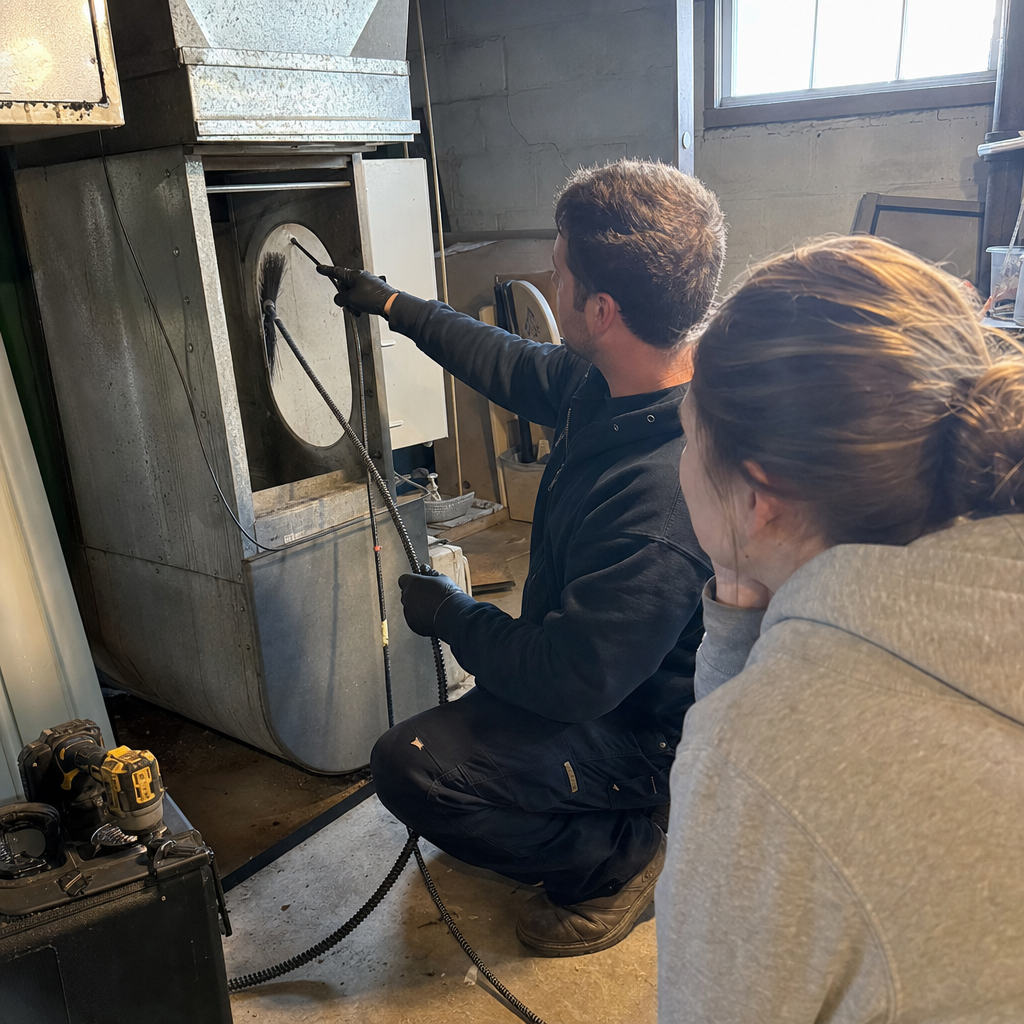
Last March, we were called to a ranch house in Westerville where the homeowner swore their dryer was “fine.” The exterior vent cap spun freely, the lint trap got cleaned every load, and clothes dried in one cycle — barely. But their laundry room felt like a sauna, and the wife had started noticing a scorched smell during the first few minutes of every load. When we ran our camera through the vent run, we found a lint dam eight feet inside the wall, right at an elbow bend. The exterior cap was working perfectly; the blockage was invisible from either end. That’s the pattern we see across Ohio, especially in homes with dryers on interior walls — and it’s why symptom-watching alone fails.
The Late-Stage Signs Everyone Knows (And Why Waiting for Them Costs You)
Most online lists repeat the same three warnings: clothes take forever to dry, the outside vent barely blows air, and the dryer exterior gets hot enough to burn your hand. These are legitimate signs, but they’re also end-stage symptoms. By the time your dryer needs two full cycles, you’ve already been overworking the heating element for months, spiking your electric bill, and letting lint accumulate near ignition temperatures.
We don’t think homeowners should need a disaster to know there’s a problem. After 11 years of cleaning dryer vents across Ohio, Joseph Taylor has developed a different standard: catch the restriction before the dryer performance drops. Here’s what that looks like in practice.
Early Sign #1: Your Laundry Room Feels Like a Greenhouse
Heat and moisture that can’t exhaust efficiently don’t disappear — they back up into your living space. If you walk into your laundry room mid-cycle and it feels noticeably warmer and more humid than the rest of the house, your vent is already restricted. The dryer is working harder to push air through a narrowing passage, and that exhaust is finding the path of least resistance: back into the room.
This sign is especially common in Ohio homes with dryers on interior walls, a layout we see constantly in ranch conversions and additions from the 1970s through 1990s. These setups require longer vent runs — often 15 to 25 feet with multiple elbow bends — and lint collects at those bends long before any external symptom appears. The humid continental climate in Ohio doesn’t help; summer humidity already pushes indoor moisture levels high, and a backed-up dryer vent turns your laundry room into a pressure cooker.
We use professional airflow meters on every Dryer Vent Cleaning in Ohio assessment, and we’ve measured exhaust temperatures 40°F higher at the dryer connection than at the exterior cap in restricted systems. That heat is going somewhere — usually, into your walls and your utility bills.
Early Sign #2: The Burnt-Lint Smell During Warm-Up
A musty or scorched odor during the first ten minutes of a cycle means lint is overheating before it clears the vent run. This is both a fire precursor and a clear diagnostic: your airflow is insufficient to carry lint and moisture out at normal operating temperatures.
Here’s the mechanism most homeowners don’t realize. Your dryer’s heating element cycles on and off to maintain drum temperature, but the thermostat reads air temperature inside the drum. If exhaust airflow is restricted, heat builds up in the ductwork behind the dryer. Lint trapped in that hot zone begins to scorch — not quite ignite, but degrade and release that characteristic smell. By the time you smell it, you’ve got a localized overheating condition that will worsen.
We carry Nikro equipment specifically for these diagnostics: airflow meters that measure cubic feet per minute at multiple points, and camera systems that let us show homeowners exactly where the restriction lives. In Ohio’s older housing stock, we frequently find that smell traces back to collapsed foil flex duct, not the rigid vent pipe at all.
Early Sign #3: Foil Flex Duct That’s Collapsed Inside the Wall
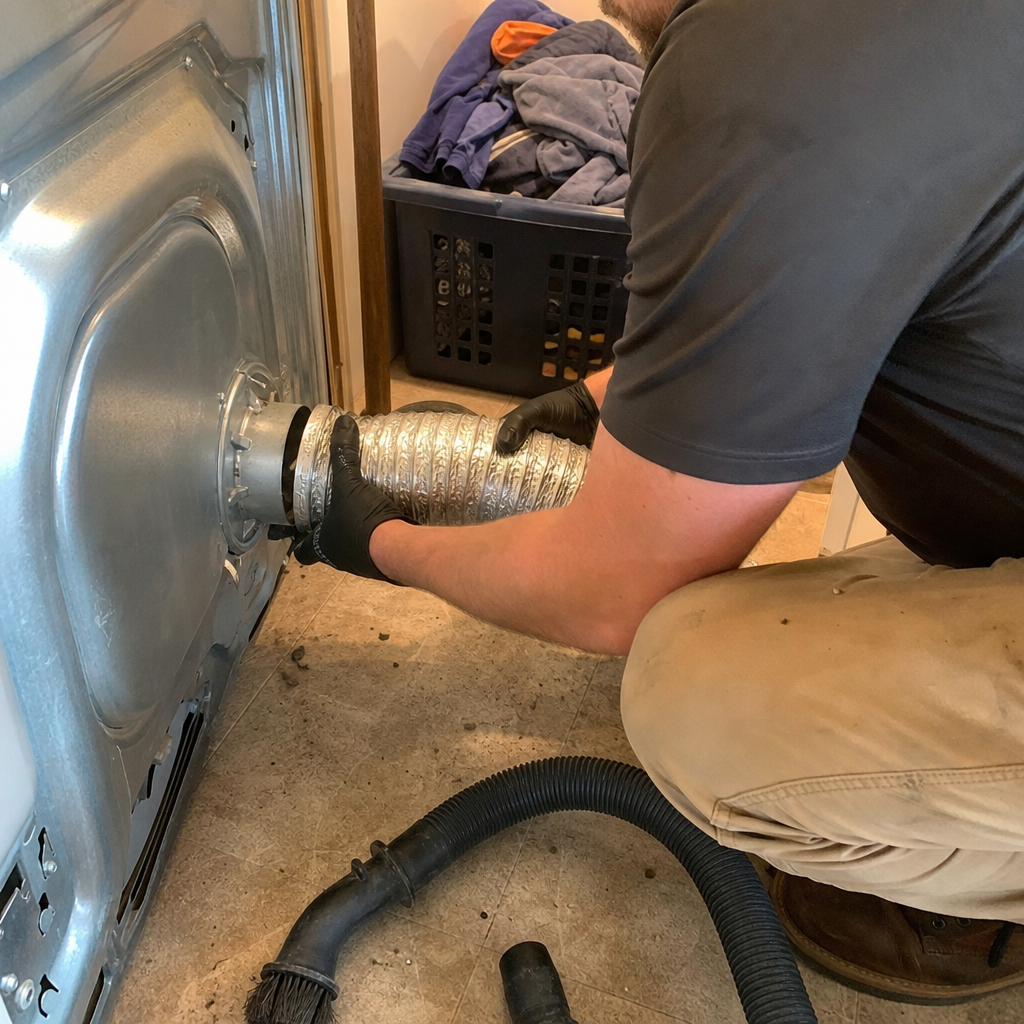
Before 2000, foil flex duct was standard for dryer vent connections in Ohio — and it’s a hidden failure point we inspect for on every job. This material collapses over time, especially where it bends to enter wall cavities or where it sags between support points. The result is a partial restriction that mimics a clogged vent before the vent itself is actually blocked.
Homeowners replace their lint trap religiously, maybe even vacuum behind the dryer, and still get poor performance because the real problem is a crushed flex duct they can’t see. A camera inspection or airflow test is the only reliable diagnostic. We use Rotobrush camera systems to verify the full vent run, not just the accessible portions.
If your home was built before 2000 and still has original dryer venting, this should be your first suspicion — not lint buildup in the rigid pipe. We replace foil flex with proper semi-rigid aluminum duct as part of our Dryer Vent Cleaning service when we find it.
Early Sign #4: The Deceptive Exterior Vent Cap
We can’t stress this enough: a spinning or flapping exterior vent cap proves almost nothing. Joseph Taylor has documented Ohio homes where the cap functioned normally while a lint dam sat eight feet back inside the wall. The cap moves because air is moving — but air can move past a partial blockage, especially on windy days or with strong dryer fans. The volume and velocity of that air are what matter, not whether the cap wiggles.
We’ve also found caps installed with screens that clog with lint debris, or flapper mechanisms that stick closed from humidity corrosion. Ohio’s freeze-thaw cycles and humid summers beat up exterior hardware. The cap is a clue, not a verdict.
Why Ohio Homes Face Unique Dryer Vent Risks
Several factors in Ohio’s housing stock and climate create conditions we don’t see uniformly in other markets:
- Interior wall dryers in ranch conversions: Common in Columbus suburbs and throughout Ohio’s mid-century housing, these long vent runs with multiple elbows accumulate lint at bend points that cameras — not guesswork — can locate.
- Pre-2000 foil flex duct: Still present in thousands of Ohio homes, this material degrades faster in our humidity swings and creates partial restrictions invisible from either end.
- Basement laundry setups with vertical runs: Many Ohio homes route vents through basements and up exterior walls; gravity works against lint evacuation, and vertical dampers fail more frequently than horizontal caps.
- Freeze-thaw damage to exterior caps: Our winters crack plastic components and corrode metal flappers, creating secondary restrictions even when the interior duct is clean.
These aren’t abstract risks — they’re patterns we’ve documented across 11 years of owner-operated service. When Joseph Taylor arrives for a dryer vent assessment, he’s checking for these Ohio-specific failure modes, not running a generic cleaning routine.
What Professional Dryer Vent Inspection Actually Involves
Our assessments use the same equipment brands — Rotobrush, Nikro, and Abatement Technologies — that commercial IAQ contractors specify for industrial jobs. For a typical Ohio residential dryer vent, here’s what we measure and document:
| Inspection Point | What We Check | Normal Range |
|---|---|---|
| Airflow at dryer connection | CFM with calibrated meter | 1,500–2,000 CFM |
| Airflow at exterior cap | CFM comparison to interior reading | Within 10% of interior |
| Temperature differential | Exhaust temp at both ends | Less than 15°F drop |
| Visual duct inspection | Camera run of full vent path | No lint accumulation, no collapse |
| Exterior cap function | Flapper operation, screen condition | Full opening, no obstruction |
When readings fall outside these ranges, we show homeowners the camera footage and explain exactly where the restriction lives. No scare tactics, no upsells — just the data and our recommendation. Clean ducts are only part of the picture; if we find damaged ductwork, we also offer Duct Repair & Sealing to address root causes.
From Inspection to Cleaning: What the Service Includes
If our assessment confirms restriction, our dryer vent cleaning service removes lint accumulation mechanically — brushing and vacuuming the full vent run, not just blowing compressed air through from one end. We also:
- Replace damaged or outdated flex duct with proper semi-rigid aluminum
- Seal connection points to prevent lint leakage into wall cavities
- Verify airflow restoration with post-cleaning measurements
- Apply Air Quality & Sanitizing treatment when microbial growth is present from long-term moisture backup
For Ohio homeowners who want ongoing protection, we recommend annual inspections for homes with long vent runs or interior-wall dryer placements. The cost of prevention is modest compared to energy waste, appliance replacement, or fire damage.
When to Call vs. What You Can Check Yourself
There are safe homeowner checks and there are tasks that require professional equipment. Here’s the line we draw:
You can safely: Clean the lint trap after every load, vacuum the lint trap housing monthly, and visually inspect the exterior cap for obvious blockage (bird nests, snow, debris). You can also pull the dryer out and check for obvious flex duct kinks or disconnections.
Call a professional for: Any work inside wall cavities, camera inspection of vent runs, airflow measurement, or replacement of duct materials. Dryer vents involve confined spaces, potential gas line proximity, and combustion safety considerations that aren’t worth the risk of DIY.
Joseph Taylor has seen too many Ohio homeowners discover collapsed duct or hidden lint dams only after they’ve replaced a perfectly good dryer. A quick call to (833) 991-6689 settles the question with actual data.
FAQs
Dryer vent cleaning in Ohio typically ranges from $120 to $250 for standard residential service, depending on vent length, accessibility, and whether flex duct replacement is needed. Homes with interior-wall dryers or vertical basement runs may fall at the higher end due to additional labor. Call (833) 991-6689 for an exact quote — estimates are free and include airflow testing.
DIY lint trap cleaning costs nothing and should be done every load, but proper vent run cleaning requires rotary brushes, high-CFM vacuums, and camera systems that aren’t cost-effective for one-time homeowner purchase. More importantly, DIY attempts on interior-wall vents risk disconnecting ductwork inside cavities or missing collapsed flex duct entirely. We’ve been called to Ohio homes where “DIY cleaning” pushed lint deeper into the system and worsened the restriction.
Annual professional inspection is the right standard for Ohio homes with dryers on interior walls, long vent runs, or pre-2000 foil flex duct. Homes with short, straight exterior vents and modern semi-rigid duct may extend to every two years if airflow tests confirm clear passage. We base our recommendations on measured data, not calendar rules — see what 227 customers say about our honest assessments.
Yes — lint is highly combustible, and restricted airflow creates sustained high temperatures in the ductwork. The National Fire Protection Association identifies dryer vents as a leading cause of home fires, and we’ve documented scorched lint deposits in Ohio vents that were weeks or months from ignition conditions. The musty or burnt smell during early cycle warm-up is your warning before visible flames; don’t ignore it. Call (833) 991-6689 for immediate inspection if you notice this odor.
If you’d rather have it looked at than keep guessing, Matrix Air Duct & Vent Cleaning Ohio offers a no-pressure assessment in Ohio — call (833) 991-6689 or visit our home page to schedule. Joseph Taylor, Owner and Lead Technician, handles every job personally with 11 years of focused air duct and vent cleaning experience.
Written by Joseph Taylor, Owner & Lead Technician at Matrix Air Duct & Vent Cleaning Ohio, serving Ohio, OH.